Get a free story when you subscribe


Age Need Not Stop You
In my twenties, I desperately wanted more stories of women kicking ass, and not needing a man to do so. I wanted female friendships, and arguments, and insecurities…all in an epic fantasy context. Twenty years ago, there were a lot less books with these core themes applied to women, especially ones that weren’t romance-focused.
To scratch my own reading itch, I wrote Heirs of a Broken Land with three central female characters who would fight each other and evil, and would lean into their powers instead of shying away from them, or giving them up for family/romance/etc…
When I reached my forties, I craved reading about older heroines saving the world while juggling family, responsibilities, and any incurred trauma (life is traumatic, you know?). So I jumped back into the world of my first series and created a second series, Keepers of a Broken Land. I’m twenty years older, so are my characters…and evil takes more than one trilogy to defeat.
Again, they’d lean into their powers, and not just pass them down to their children like so many fantasy stories do. They’d try to make right the stuff they screwed up, no matter how haunted they were, and they’d still support each other and keep fighting.
Now hungry for stories of middle-aged protagonists in science-fiction and fantasy, I leapt from book to book, devouring stories of people still standing up despite scars and creaky knees. (I discovered crones, too. Inspiration for Future Marie!)
There’s this thing about loving books where you just want to scream about them to everyone. And that’s what I wanted to do with the stories I discovered, so I decided to put together a Story Bundle that focused on characters 40+.
It was a crazy, joyful experience, and I’m very proud of the ten books gathered in this bundle. From heroes looking for redemption to crones tasked with saving the world (despite not being able to find her reading glasses), from grandmothers trying to save their community to old friends trying to save each other, this bundle will cure you of any conception that older folk can’t save the world.
YA fever has been sweeping the fantasy genre for decades, and generation after generation is told that “they’ll be the ones to clean up the planet/save the world/stop the evil.” … Time to stop putting all the onus on youth and time to step up, no matter your age! Because, if we’re lucky, we’ll all grow up to be middle-aged, and then crones (and other gender equivalents), and we need to help light the night for those following. No passing the buck to younger generations—let’s work with each other, instead.
Because you can be 40+ and still kicking butt.
I hope these ten amazing books will inspire and entertain you as much as they did me! The Story Bundle is available until November 21, so make sure to grab it now!
—
Marie Bilodeau is an Ottawa-based author, TTRPG game writer, and storyteller. Her speculative fiction has won several awards and has been translated into French (Les Éditions Alire) and Chinese (SF World). Her short stories have also appeared in various anthologies and magazines like Analog Science Fiction and Fact and Amazing Stories. Marie is also a performing storyteller and has told stories across Canada in theatres, tea shops, at festivals and under disco balls. She’s won story slams with personal stories, has participated in epic tellings at the National Arts Centre, and has adapted classical material. In her spare time, she’s also the chair of Ottawa’s speculative fiction literary con, Can*Con.


I have a love affair with footnotes.
Maybe it’s because of all the academic papers I had to write throughout my career as a teacher, but I think I fell in love with them before high school and college, back when teenage me was devouring speculative fiction books at a rate of one or two per day.
Books like Robert Asprin’s MythAdventures series were a mad mix of fantasy and humor, where footnotes were used as a way for the author, the characters, or both to leave commentary on what was happening aside the plot line. Asprin used footnotes as a comedic schtick, one that worked well for his various series.
As a young writer, I took his example to heart. This was something real writers did. Imagine my surprise when adult writer me found very few footnotes used in fiction at all. (Though this is changing thanks to the LitRPG genre.)
Many people hate footnotes because of their association with MLA citations and research papers, two topics often considered tedious, but who says they have to be? Why can’t authors use them in their fiction? Why can’t a story about dragons have footnotes, too?
While I haven’t gone so far as to use footnotes in my fictional work as of yet, they came in handy during the writing of my first memoir. Because the book covers everything from gender identity, sexual orientation, and transphobia to medical gaslighting and abuse, I found myself needing to clarify most of what I was talking about, if for no other reason than to insure I was educating folks rather than confusing them.
For example, it’s challenging to discuss demisexuality if the reader has no idea what that is or why it’s important. More than that, the footnotes served as a way for me to insert humor and my own wry sarcasm in between the sentences of some very serious topics. As I wrote, I found myself escaping into the footnotes like they were their own substory within the story I was framing.
More importantly, they reminded me of what it was like back when I was twelve. Nothing in the life of an adolescent is simple. Between hormones and peer pressure, the life of a teenager is complicated and messy. Toss in figuring out whether or not your queer, child abuse, and poverty and well… let’s just say there’s a reason child-me escaped so frequently into the worlds of speculative fiction.
Tapping into those feelings and the joy I found in so many tales helped me remember the good inside of the bad that has often been my life. It’s easy to get lost in the trauma, or to believe the depression and anxiety when its roars are sometimes deafening, but the footnotes were a reminder that humor has always pulled me out of the darkness.
Just like speculative fiction, humor has always been a means of escape.
Voices Carry may be a non-fiction memoir, but in the writing of it, I rediscovered the importance of humor…and footnotes!
—
Multi-international award-winning speculative fiction author Raven Oak (she/they) is best known for Amaskan’s Blood (2016 Ozma Fantasy Award Winner, Epic Awards Finalist, & Reader’s Choice Award Winner), Amaskan’s War (2018 UK Wishing Award YA Finalist), and Class-M Exile. She also has many published short stories in anthologies and magazines. She’s even published on the moon! Raven spent most of her K-12 education doodling and writing 500 page monstrosities that are forever locked away in a filing cabinet.
Besides being a writer and artist, she’s a geeky, disabled ENBY who enjoys getting her game on with tabletop games, indulging in cartography and art, or staring at the ocean. She lives in the Seattle area with her wife, and their three kitties who enjoy lounging across the keyboard when writing deadlines approach. Her hair color changes as often as her bio does, and you can find her at www.ravenoak.net.

Oops, I tripped and dropped a short story collection…
Sometimes the thing to get you out of a funk is to get back to your roots. And sometimes what comes out of that is everything you never knew you needed.
Or at least that’s what happened to me.
I didn’t set out to write Afoul & Affairs. Much like many of my other projects over the years of my career (See: the Femmes Fatale series), this collection was an accident. All of my deadlines were met, and I didn’t feel ready to dive into writing another novel. But I wasn’t happy with the notion of professional inertia setting in the way I know it will when I let myself spend too long away from my office. I knew I needed to be writing, but I didn’t know what to work on. I was annoyed with myself. And then it hit me.
Do what you used to do when writing was just for fun.
I started out my [adult] writing life in fanfiction. And my bread and butter was always missing moments. As a teen, I would type up pages of could-have-plausibly-been-cut-scenes from the X-Files on my Panasonic typewriter for my high school best friend to input on her home computer and send into the MSR mailing list on Yahoo.
In college, it was Star Trek: The Next Generation and the occasional Josh/Donna vignette from The West Wing. Then there were the years I spent in that British magic school—especially in the era when I worked in a related exhibit at the Pacific Science Center. And always, peppered within these fan works, were the stories of Han & Leia from the Star Wars films and the novels we now call Legends.
Missing moment fic is my wheelhouse—my area of, if not expertise, then certainly ample experience. It’s what I’ve always done best and a thing that has forever brought me joy.
When I started writing novels, one of the most difficult things to wrap my brain around was what to leave off the page. Suddenly I was not the one to fill in the missing moments, but rather the person charged with supplying missing moments to be filled by fanfic writers in the future.
That. Was. Weird.
With my debut, it took a lot of help from my editor (shout out to Dawn at DefCon One!) to tighten up the book’s pacing. The work I did left, in its wake, many missing moments, and I had to be okay with friends and fans making up their own scenarios to fill those in. It was definitely an adjustment.
Fast forward to 2024 and the 20th anniversary of Cobalt City. This year is chocked full of releases from half a dozen authors working in and adjacent to the Cobalt City IP. That got my wheels spinning. All these books are connected, and the way we all work together means characters are moving in and out of different authors’ custody. And since not everything being released this year is in chronological order, we’re all having to take into account things that have happened that readers won’t know about yet. It’s absolute IP/Crossover/Collaborative heaven, but it also left room for more missing moments than I could possibly let lie.
The decision as to where to end Time & Again was tough, as there was so much more I wanted to make happen between these characters. But the book was already a chonky 120,000 words and ending it with the bad guy defeated, the team disbanded, and the lovers happy for now made all the practical sense in the world.
Sea Change came first, giving Ruby and Angel the time they needed to begin forging the bond that’s going to carry them through some tough times another author has coming down the pike. Then I wrote Sidekick Business, because I wanted to play with the idea. Finding Out actually takes place before Time & Again and I mostly wrote it to tell myself what went on between those two characters. I’d been poking at the idea for Goals for a while, because I found the whole scenario delightful and Settling the Score was mostly the result of having season tickets to the Seattle Kraken.
And this being an election year, I couldn’t help myself but to spend some time playing with Ruby and co.’s plan to foul the plans of a fascist President seeking re-election. In The Arena emerged as the longest piece in the collection and I’m particularly proud of the new heroes I was able to introduce in hopes of future fans picking them up for fic of their own.
One of the most amazing things about writing in a small press IP is how encouraging and supportive everyone is. The idea that these stories, which had come into existence over different timelines and for different reasons, should be collected and published was never in question to anyone but me, apparently.
To my surprise and delight, the 45,000+ words in this collection also put the Ruby Killingsworth series in Best Series contention for the 2025 Hugo Awards, part of Seattle Worldcon, for which I was already excited as a local to the area. My desire to add the words “Hugo Nominated” to my bio and to attend the storied Hugo Losers Party in Seattle are things I’ve never made a secret of, and I find it so very fitting that this collection is the thing that could make that happen.
Writing these stories, these missing scenes, these tight exchanges and moments of instant but important growth for my characters and their relationships, felt like home. And it was just the thing to get me in the chair and writing again after all my novel deadlines had been met and starting another novel felt like too much. These are the kinds of stories I’ve always written, the kinds of stories I’m perpetually drawn to. Giving myself permission to return to the art of writing short fiction and to playing with the possible has been a joy and a delight and I am so excited to be sharing that joy with readers.
—
Amanda Cherry is a Seattle-area queer, disabled nerd who still can’t believe people pay her to write stories. She is the author of five published novels as well as TTRPGs, screenplays, and short fiction, and a cast member with the Dungeon Scrawlers on Twitch. Her nonfiction writing has been featured on ToscheStation.net, ElevenThirtyEight.com, and StarTrek.com. Amanda is a member of SAG-AFTRA, SFWA, & Broad Universe. Follow Amanda’s geekery on Twitter, BlueSky & TikTok @MandaTheGinger or visit www.thegingervillain.com
Today, Tamara Kaye Sellman tells me how her vivid imagination is augmented by her dream life and how both inspire her writing.

It’s funny that I should sit down intending to write to you about how my dream life serves such an active part in my writer’s toolkit today. I just found out a flash fiction of mine has been accepted for fall publication. I based this story on real-world events related to a prescient dream I had as a teenager.
That dream occurred on the night of the day of the Jonestown Massacre. This was November 1978, back in the days before the Internet, when people still read newspapers and watched day-old TV news. There was no way for me to know this had happened until the following morning, when I sat down for Sunday breakfast. My family spent those mornings wrapped up in the Sunday Oregonian, which had only just begun to sport four-color ink on the front page, and only on Sundays.
That particular Sunday, the pictures of the Jonestown Massacre screamed from both above and below the fold of the front page. When I saw those pictures, and read the story, I threw up.
This wasn’t necessarily unusual for me; my parents chain smoked. Between the smell of cigarettes, pancakes, Mrs. Butterworth’s, rank coffee, and burnt bacon, I had reason enough to feel queasy like any other Sunday.
So I used that as my excuse for going back to bed because what could I do with this information? Share it? In 1978, I was a slight girl in a boy-heavy family; my thoughts and feelings were routinely rejected. I was always told I was too sensitive, I needed a thicker skin, I had a vivid imagination that might get me into trouble.
Fast forward a couple decades later. My toddler daughter, in her car seat, keeps saying something about a house we’ve just driven past on our way to the grocery store. It makes no sense to me then. Not until I read the news in the paper about a horrible crime committed at the very same house. And then what she told me made perfect sense: she basically knew where the evidence was. (Suffice it to say, F*ck yes, I believed her.)
Fast forward another 25 years, and the story I wrote, “Early Childhood Education,” will appear in the Lowestoft Chronicle this fall. It’s my third? fourth? fifth? rendering of this story. I’ve written it as a straight up personal essay, as a script for a storytelling festival, as a prose poem, as a full-fledged short story, and now, as a flash fiction. What’s been my problem? Figuring out how such a story might end.
No version ever fit until this last one. I ran it by my critique group; it seemed to work well enough, so I went fishing (that’s what I call submitting). And now my true story wrapped up in flashy packaging will see the light of day.
My dream life isn’t vivid in this way very often, by the way. Rarely prescient. I’ve had a few dreams that predicted moments that came true, none of them significant. Several involved loved ones recently passed, as if they were saying au revoir.
Now, most of my dreams come as little movies with story arcs. Sometimes I find myself in serial landscapes: dreamscapes I return to again and again, to experience different, fully formed adventures.
I chalk all this up to a few things. First, it’s probably just genetics: my dad and his brother had rich dream lives also, so I think it’s just something I

inherited. Second, because I’ve written and told stories my whole life, my brain naturally ascribes meaning as it happens in the events that unfold in my dreams. Third, I’m also a lucid dreamer, which perhaps throws fresh dimension into things, though I try not to mess with the stories that unfold.
And another thing. I’m looking at my new dark speculative collection coming out in July 2024 from Aqueduct Press: Cul de Sac Stories. Checking out the TOC, I’d not noticed until well after the book had gone to press those six of the eight stories in there either originated through dream narratives, or they actually use dreams and nightmares as plot devices.
All I’m saying is this: those nightly adventures you sometimes remember, sometimes can’t? That’s rich material, right there. Nurture it, even if it scares you. Even if nobody believes you. There’s a goldmine in there.
—
Tamara Kaye Sellman is author of Cul de Sac Stories (2024; Aqueduct Press), the experimental novelette, Trust Fall (2024; MCR Media), and Intention Tremor: A Hybrid Collection (2021; MoonPath Press). She is the other half of the BENEATH THE RAIN SHADOW podcast with Clay Vermulm. Her collaborative horror collection with author Clay Vermulm, Rain Shadows, will be released in 2025. Other recent or forthcoming appearances include Lowestoft Chronicle, Lurking (from the Dark Decades Anthology Series), Quibble, Cirque, Turtle Island Quarterly, Verse Daily, MS Focus, and the WRPN Womens International Film Festival (her debut poetry film, LOOK UP, earned bronze laurels there in 2024). Tamara’s work has been nominated for the Pushcart Prize and earned other awards. She is currently at work on two novels (magical realist cli-fi and post-apocalypse), two poetry chapbooks (Pacific Northwest gothic and tributes to esoterica), a New Weird flash fiction collection, an inspirational essay collection titled RootLeaf Stories, and more experimental poetry films.
Today we have one of my favorite people, voice actor Trendane Sparks. He talks about the value of human performance in book narration versus the lack of emotional context of AI “narrators.”

When you’re watching someone perform live music, sometimes they mess up. They miss notes or they forget lyrics and they have to recover with, hopefully, some measure of grace. Maybe with laughter. But it is those imperfections which make a performance really memorable, really endearing. While studio versions have been “perfected” with adjustments to pitch or tempo or whatever, it loses some of that aliveness and starts to feel very mechanical.
I guess I’d say that’s what makes voice acting the most enjoyable for me, including narration. The story contains the lines, the setting, the stage direction. All of it. And the ‘imperfections’ may not be written in the text at all, but are clearly implied by it. A character who is nervous or afraid might stammer, one who is crying may sniff or cough as they choke up. Voices may crack, breath may be ragged, huffing in frustration, or the gurgling in the throat as someone is dying. Even if they aren’t specifically noted in the letter of the story, they can be inferred from the context of the scene and they add a tremendous amount of character to the…well…characters.
Some might say that such thinking only applies to the characters. And, in many cases they would be correct. But when one of the characters is also the narrative voice, I feel like it works. Maybe not open sobbing or physically emotive stuff like that. But if they are happy, afraid, sad or any of that stuff, it should be detectable, even in their internal voice. In a scene like a chase or other, high tension moment, the pace should be faster. Not quite too fast for the listener to keep up with, but fast enough that they have to focus more so as not to miss anything.
There are some who feel that we should not deviate in any way from the words on the page; that the author’s words are sacrosanct. And I’m not saying that we should change them, per se. But as we bring the work into a new medium, some elements can be used to make the work even better. That’s why I feel it is so important to not simply read the text, but to perform the story as any actor worth their salt would.
When it comes right down to it, we are actors. As such, it is our job to bring our audience along on a compelling and fulfilling emotional journey. We have to make them feel, or at least relate to, joy, sadness, fear, anger and all the other emotions in a story. It is the ‘imperfections’, the deviations from or additions to the exact text on the page, which elevate our work from that of AI or a text-to-speech engine to the true human expression we call Art.
—
Trendane Sparks. Born in Texas when Unleaded gas was ‘fancy’ and still under 25¢ per gallon, Tren eventually wound up in California where he crawled through fiberglass insulation to run CAT-5 cable, did tech support for Netcom, had several jobs on a PBS children’s show, worked as a freelance mascot performer and did videogame QA. Then he became a voice actor and life became fun again! Now you can hear his voice in games, animations, and audiobooks. Most commonly, he narrates Catalyst Game Labs in the BattleTech and Shadowrun franchises as well as for the DrabbleCast, Escape Pod, and PseudoPod podcasts.
Today, Cat Rambo talks about a stellar opportunity (sorry, not sorry); one that I would be partaking in if it weren’t for the small problem of me being in Canada at the time of the next Wayward Wormhole workshop. In all cases, I really want to experience a Dark Sky reserve at least once in my life.

Last year while in the inaugural Wayward Wormhole workshop, which took place in a castle in Spain, we used a telescope a lot, particularly to look at the moon as well as the surrounding mountaintops. This year, the skies will be even more telescope-worthy in our latest location.
One reason (among the many) I’m excited about this year’s Wayward Wormhole workshops (one for novels, one for short stories) happening in New Mexico, is that the area is part of a New Mexico Dark Skies reserve, where people are encouraged to use flashlights rather than larger lights. The elevation plus clear skies plus an absence of light means that the star-watching will be exceptional. (If you’d like to know more about the International Dark Sky Places program, here’s some details: https://darksky.org/what-we-do/international-dark-sky-places/)
* The succession of celestial events starts with a new moon on November 1. Surely a good omen for the Wormholers arriving to attend the novel workshop with Don Maass and C.C. Finlay.
I know we will definitely get some star watching in, and a little sight-seeing as well, since Tombstone’s in driving distance. And imagine what kind of words one can write under a sky so bright you can see the Milky Way in all its glory! I can hardly wait.
If you’re curious about the workshop, the deadline for applying for the short story workshop is at the end of this month! Find more details here: https://www.kittywumpus.net/blog/the-wayward-wormhole-new-mexico-2024/
—
Cat Rambo’s 300+ fiction publications include stories in Asimov’s, Clarkesworld Magazine, and The Magazine of Fantasy and Science Fiction. In 2020 they won the Nebula Award for fantasy novelette Carpe Glitter. They are a former two-term President of the Science Fiction and Fantasy Writers of America (SFWA). Their most recent works are space opera Devil’s Gun (Tor Macmillan, 2023) and anthology The Reinvented Detective (Arc Manor, 2023), co-edited with Jennifer Brozek.
For more about Cat, as well as links to fiction and popular online school, The Rambo Academy for Wayward Writers, see their website.
Today J.W. Donley talks about how limits can give you the freedom you need to write. I know, personally, that I work better within guide rails. When I have too many options, I get stuck trying to create my own limitations.

Writer’s block sucks. As a writer, there is nothing more stressful than staring at the blank page and then the sense of self defeat when the page is still blank after hours and hours of mental strain.
Some writers claim that writer’s block does not exist. And I get that sentiment. You can always write something. Just start putting down pointless words until something useful pops out. While this is great to get going at times, I don’t find that sort of writing to be the most helpful. It usually leaves me with more of a mess than workable prose. But, if that’s your vibe, you do you.
And if you feel the same way or would like to explore another option, I have a different idea when it comes to the blank page.
What intimidates me most is the absolute scope of what I could write. So many options that I just shut down as my brain bounces from idea to idea without developing any of them enough to really get ink to paper.
How do you control your brain and help direct it down a workable path?
What works best for me is the limitation of scope.
I love limitations when it comes to starting a writing project. They help to scale down the universe to something manageable. Or at least manageable enough to squeeze out a story.
I’ve used prompts since the very beginning of my writing endeavors, but I really didn’t take them seriously until after I participated in the NYC Midnight Short Story contest a couple years back. The way their contest works is they assign you a random character, genre, and object each from a small list. For instance, I think I got a security guard with a stapler in a heist story. I had never written a heist story before, but after a quick bit of research I picked up the major tropes and then I was off to the races. The story ended up being my first professional sale. I’m still in slight shock that this story was my first pro sale. What made this story work is that I was able to limit the scope of possibilities enough to quiet my brain and get down a full story idea in a short amount of time.
Some might worry that limitations like this can water down your own creative voice, but I do not support that at all. My story was very much a J.W. Donley story after it was finished. It was of course a horror story in the end, but it was also still a heist. And I didn’t end up using a stapler, but I did put in a typewriter. It just worked! It was much shorter than what I usually end up with, and thus easier to find a market for.
Now, after you have that first draft and have a full story, you can let go of the limitations if you wish. Feel free to mold the story in any direction, let the universe speak to you and cajole new spice into the prose. But, do not let go of the reins of rules and limitations until you have that complete idea finished.
So, the next time you get stuck, find some way to limit your choices. Be it tarot cards to toy with your subconscious, randomized Wikipedia articles, or a good book of writing prompts, find something that works for you.
—
J.W. Donley—HWA and HOWL Society member—lives with his family in the Pacific Northwest where the Cascade Mountains meet the Salish Sea. J.W. is the author of the novelette Cats of the Pacific Northwest and the brand new 100 Unusual Prompts for Writers of Horror, Weird, and Bizarro Fiction with contributions from John Langan, Carlton Mellick III, Shane Hawk, and many more. His short stories have appeared in anthologies from Dim Shores, HOWL Society Press, PIT, Chuckanut Editions, and on Creepy, a Horror Podcast.
Today, Emily Bell tells us why she and her publishing house stepped into the world of foreign language translations and what she learned in the process.

Hello – I’m Emily, a fantasy writer as well as an editor for Atthis Arts in Ferndale, Michigan. And of all the projects I ever saw myself taking on in a strange and uncertain future, I did not see Ukrainian translations. I’m not Ukrainian, or of Ukrainian culture or descent. So how did our little press in Ferndale get involved with Ukrainian translation? And what have I learned from it?
My spouse was pulled aside at Can*Con in 2022, to talk about a collection of stories hoping to raise money for Ukrainian charities. It had stories, it had a grant, but it had lost its publisher. We looked into it, knew the need for Ukrainian independence, and agreed to help.
I will not get into the details, but the more we learned, the more it unraveled. We lost the grant, we lost the editors, there were issues with the stories. Right as it was about to disintegrate, Chicago writer Valya Dudycz Lupescu, my spouse, Chris Bell, and I had a serious talk. This was too important, and we would not go back to the Ukrainian editors with the sound of explosions outside of their windows and tell them this wasn’t happening, after all their work, because it got too hard. We weren’t in a position to continue it as a direct fundraiser, but we would share these stories. We would make it work.
This is where the world stepped in. Ukrainian translators got us connected to the Ukrainian Book Institute, who offered us a grant. More than 1000 backers from over 30 countries helped fund the rest of the costs. Volunteers helped us get the book done on the grant schedule, reviewing, editing, proofreading. Embroidered Worlds: Fantastic Fiction from Ukraine and the Diaspora, edited by Valya Dudycz Lupescu, Olha Brylova, and Iryna Pasko was born. I sometimes lightly refer to this collection as “the book that made people fall asleep on their laptops all around the world.” But truly, it is a triumph; of Ukrainian art, spirit, and culture—and the power of global solidarity.
What have I learned from all this? Human translations are vital. They cost money, yes, as they should, but they are vital. There are nuances and choices to translation, much more than right or wrong or literal meaning. Thoughtfully translated stories share culture, share hearts, connect us. They are always, always underfunded. The people who advocate for them exhaust themselves appealing to those with resources.
If you are reading this, I ask you: please advocate for translations. Read them. Fund them. Talk about them.
As a personal note, if I had life to do over again, I would have been a translator. I was taught I had to do something that “made money,” hence my two engineering degrees. But, now I can give back. Now I can do something I never expected. This experience (and other personal issues) have also revived my passion for language. I’m currently learning and practicing four languages other than my own, and it is making me a happier, fuller person. It is helping me connect with the world.
Once the book was done, we shelved our exhaustion and moved on to a now packed release schedule, and vowed: no more surprise projects. Then we learned, within a couple days of another grant timeline, that Ігор Мисяк, a poet, a writer, and a combat medic now volunteer solider, had recently published a novel, Завод, before being killed by Russia. And it was available for translation.
The project, which will be The Factory by Igor Mysiak translated by Hanna Leliv, spoke to me. In the language of poets, the language of sorrow, and the language of hope.
I hope it will speak to you, also.
To Igor, I see you. And I look forward to reading your words. They will stay with me.
To the world, keep writing. We will find ways to share our stories.
—
E.D.E. Bell (she/her or e/em) is a fantasy writer and small press editor. A passionate vegan and earnest progressive, she feels strongly about issues related to equality and compassion. Her works are quiet and queer and often explore conceptions of identity and community, including themes of friendship, family, and connection. She lives in Ferndale, Michigan, where she writes stories, revels in garlic, and manages the creative side of her indie press, Atthis Arts. You can follow eir adventures at edebell.com.
Today Xan van Rooyen tells me why a book may need to be re-written multiple times before the writer grows into the author the novel needs them to be. Then, and only then, can that story be told as it needs to be.
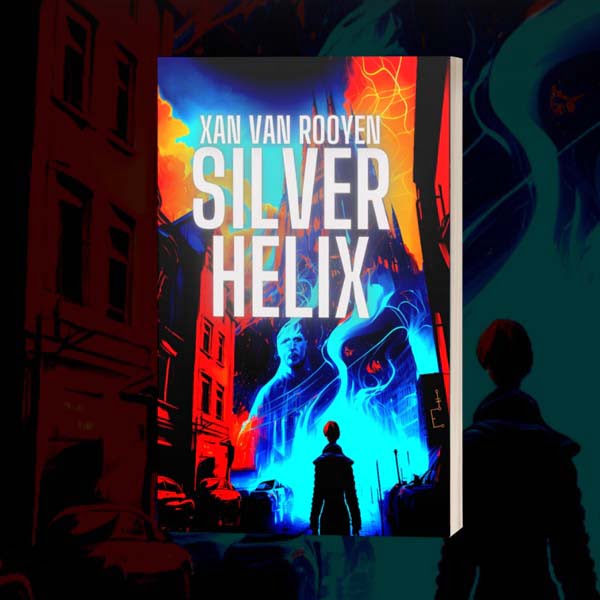
Silver Helix took me 12 years and 5 rewrites before it was ready for publication and found a home with Android Press.
This book became the YA novel that landed me my first agent, but never sold, possibly because it was a little too odd and a lot too queer for the industry back then. At the time I began writing this book, I had no idea I was non-binary. I knew I wasn’t comfortable in my own skin despite how hard I tried to embrace my assigned sex at birth. For years I thought if I could just perform ‘girl’ better, then happiness and validation would follow. Thus the only reason I wasn’t happy being ‘girl’ was because of my own failings.
I shelved the book and wrote other stories, all queer, all helping me explore aspects of myself I was struggling to name. “Write what you know” is an adage attributed to Mark Twain, a statement sometimes erroneously taken literally when really it means to be aware of appropriation and to write authentically, doing due diligence when writing characters with identities different from your own. Thing is, for years I was writing what I didn’t know I knew. Deep down I knew I wasn’t cis but I didn’t have the vocabulary or the self-awareness to find a label adequately describing who I was.
It took years of self-discovery and writing a variety of queer characters, inserting myself into their bodies and minds, to understand my non-binary identity. While I remain wary of labels, I eventually started using non-binary and bisexual to describe myself, and later realized I needed to add demi-ace and possibly pansexual to the mix since identity can be fluid as people change, evolve, and gain better understanding of themselves.
When I proudly displayed these labels on my social media pages, I thought I was done. The self had been realized. This was the truth I’d always secretly known, but not been able to articulate. This was why I’d been writing queer stories for as long as I could remember while masquerading as cis and mostly het.
Turns out, I’d not only been writing queer characters before I knew I was queer, but I’d been writing autistic characters (or at least characters with autistic traits) long before I ever imagined I was autistic, too.
Struggling with sudden and debilitating mental health issues, I self-diagnosed myself with everything from a brain tumor to psychosis, but eventually connected with a therapist who recognized autistic traits in me and recommended an evaluation. Almost 18 months later, I had officially been diagnosed with autistic burn out and my identity had once again been altered.
It was only with diagnosis in hand that I remembered all the times editors had called my characters quirky or idiosyncratic with peculiar habits (all little pieces of myself I had inadvertently written into my stories). I realized I’d been writing autistic characters for years the same way I’d been writing queer characters.
So, back to Silver Helix, which I rewrote a fifth and final time while getting diagnosed. It was simultaneously a source of escapism and a way for me to process a potential new identity. I never meant to write an autistic character in Silver Helix, but I’m so glad I did. I’m so glad my journey of self-discovery is reflected in my character as they grapple with their own identity, and I’m so grateful I will get to write a sequel in which my character will learn to love and accept themself the way I am still learning to love and accept myself.
—
Climber, tattoo collector, and peanut butter connoisseur, Xan van Rooyen is an autistic, non-binary storyteller from South Africa. You can find Xan’s stories in the likes of Three-Lobed Burning Eye, Daily Science Fiction, and Galaxy’s Edge among others. They have also written several novels including YA fantasy My Name is Magic, and adult aetherpunk novel Silver Helix. Xan is also part of the Sauutiverse, an African writer’s collective with their first anthology Mothersound out now from Android Press. Feel free to say hi on socials @xan_writer. Linktree: https://linktr.ee/xanvanrooyen
Meet author Amanda Cherry. A good friend of mine who I have worked with before. Today, she tells us something most of us authors know but need to re-learn from time to time. Especially when writing the second or third (or, ahem, fifteenth) book.

Trust The Process.
That is a piece of advice all creatives hear at one time or another. It’s meant to be encouraging—to remind us that whatever mess we’re looking at can and will turn into the beautiful thing we’re intending to build. It’s a reminder that even the most exquisite painting likely started life as a rough sketch; that your favorite song probably started as a bit of melody stuck in a composer’s head or a catchy couplet scrawled into a notebook or onto a diner napkin.
Trust the process is the phrase that says: “The only way out is through, so keep going!”
The problem, when someone is new to creating things, is that the process is a stranger. And we’ve been conditioned all our lives not to trust strangers—especially not with things that are dear to us.The first time I traveled in Europe, we wound up taking an overnight train. The procedure on that train was for someone to collect all the passports in the evening so the railroad handles all the border crossings while the passengers sleep. This sounds good in theory, but in practice, it’s terrifying.
Here I was, in a foreign country where I didn’t speak the language, being told to surrender the one and only document that could prove my identity and my right to be there to a middle-aged woman in polyester pants.
I didn’t sleep so well that first night.
But the next morning my passport was returned to me over a cup of espresso, stamped with the names of the countries we’d passed through while we slept. All was well.
So the second time we took an overnight train, it was a little bit easier to hand my documents over—because I’d done it before, and everything had worked out fine. It turned out the person who collects the documents was in uniform—it just wasn’t my expectation of a railroad uniform. I recognized the uniform. I recognized the process.
By the third time I took an overnight train across several borders, I had zero anxiety left when asked to hand over my passport. Because I’d learned to trust the process.
Writing books has turned out to be a lot like that.
When I first had the idea for TIME & AGAIN, I had just released its predecessor (my debut) and I only had the vaguest idea of what I wanted the sequel to be. I knew I wanted a time travel story, and I knew I wanted a second chance romance.
But I had no idea of anything beyond that. Most critically, I had no idea who the time travelers were nor what they wanted with my main character.
It took me nearly five years to sit down and write this book in earnest. Because it took me finishing three more books, and seeing them published, to trust the process. Just like the overnight border crossing, my ability to get through draft after draft became familiar and trustworthy with time and repetition. And, sure enough, the answers revealed themselves as soon as I let myself sit down and do the work.
And I think y’all will enjoy the result.
—
Amanda Cherry is a Seattle-area queer, disabled nerd who still can’t believe people pay her to write stories. She is the author of five published novels as well as TTRPGs, screenplays, and short fiction, and a cast member in the Dungeon Scrawlers GREYMANTLE game on Twitch. Her nonfiction writing has been featured on ToscheStation.net, ElevenThirtyEight.com, and StarTrek.com. Amanda is a member of SAG-AFTRA, SFWA, & Broad Universe. Follow Amanda’s geekery on Twitter, BlueSky & TikTok @MandaTheGinger or visit www.thegingervillain.com