Get a free story when you subscribe


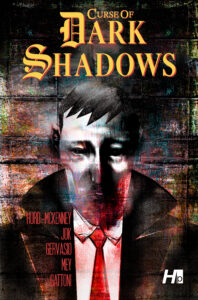
During the pandemic, I was in a comics writing group. I was convinced we’d all be dead and there would be no more conventions. Conversations turned, as they inevitably do, to the franchises we’d love to take a crack at. I have always encouraged creators to focus on their own ideas more so than other IP, so I dreaded the conversation getting to my turn. And when it did, I began to answer (shocking myself even): it was Dark Shadows.
You see, I’d also been rewatching Dark Shadows (the entire 1225 episode catalogue) during the pandemic. If it was all going to be over, what better family to go out with than the Collins family of Collinsport, Maine? So as I began to answer the IP question, the idea for the story sprang, fully formed, into my mind. That very rarely happens for me as a writer.
No spoilers here, but thematically, inspiration can be found in WE HAVE ALWAYS LIVED IN THE CASTLE by Shirley Jackson.
There’s Truman Capote and Harper Lee and William Faulkner all in there, too, but all good Dark Shadows storylines were based on some classic fiction. So my approach would be Southern Gothic, channeling my own lived experience and my fractured family ties into a story about the Collins family. Why Southern Gothic? It’s hallmarks: dilapidated mansions, deeply flawed humans usually entrapped in a generations-long family feud, and the sinister events which arise from all of the above. If you know Dark Shadows, then you can see the connections.
I do feel connected to Dark Shadows. My mother would race home from school to watch when the show was originally airing. I haven’t spoken to her in almost 15 years, thus this project was an incredibly healing one. I found the resolution I won’t find in this life. I’m at peace with that. We never discussed Dark Shadows when I was a child. I knew she liked it. While we shared a love of the show, what could have perhaps made us closer never did. But in watching the show in its entirety, I felt that I was able to make a relationship with it (the show) separate from her, and also resolve some of our conflict for myself in writing this new chapter of the show.
So here we are, almost three years later from the comics Discord discussion, and the book is coming out soon. There’s a short and sweet story behind my entrance into the officially licensed world of Dark Shadows, but I’ll save that one for another dark and stormy night.
—
Craig Hurd-McKenney is a Xeric grant recipient and Ignatz-nominated comic book writer living in Seattle, WA. He has been making comics since 2000. For more information about Craig, please visit: https://www.hspcomix.com/

 Answering the question of WHY DO I WRITE? (something I encourage all writers to do), I have concluded that my WHY is this: I write to tell stories about underrepresented people and underrepresented places in a way that is accessible, and hopefully, entertaining.
The underrepresented place I most often write about is Saskatchewan, my home province. The underrepresented people I most often write about are members of the LGBTQ+ community. The combination of the two is, I feel, truly underrepresented and rarely found in Canadian mystery genre material.
As a writer writing about LGBTQ+ characters, I have on occasion encountered people, usually interviewers or reviewers understandably looking for an angle, decide that I am the spokesperson for that community. They are mistaken. I am one person, one voice. Deciding I am the spokesperson for the LGBTQ+ community is like a Martian, freshly landed on earth, deciding I am the spokesperson for all humans.
That being said, as a mystery writer who is a member of, and advocate for, the LGBTQ+ community, my hope is that my singular voice, my presence and representation in the publishing industry, encourages more voices to speak out and helps to move the community out of the category of being underrepresented.
Even so, I have found you cannot please everyone, outside or even inside your own community.
I was fortunate to find a publisher for my first book without agent representation. I was about 4-5 books into my first mystery series when I received a letter from a graduate student completing his Master’s thesis at Carleton University. I was quite surprised—and I must admit, rather flattered—to learn that the subject of his thesis was my Russell Quant series.
He sent me a copy of the abstract which, in part, read…now, keep in mind the series has a main character who is gay:
“With Russell Quant, Bidulka has shifted the originally well-defined, straight-forward, stolidly masculine identity of the hard boiled, urban crime-fighting hero to a marginal landscape, where subversion, introspection, and humour reign.
“In this paper, I contend that Bidulka’s writing queers not only for the detective fiction genre, but also the regional landscape that his imagined communities inhabit, and myths of Canadian nationhood that bind them.”
Making no claim of being a great academic or literary scholar, I readily admit I didn’t really understand most of the abstract’s claims—but it sounded pretty good.
Some months later, this same grad student sent me a copy of his now published thesis. Once again, this was a high-minded, rather lengthy, scholarly document, but I was smart enough to recognize that in slow methodical fashion this student had deconstructed every book in the series and then completely tore them to shreds for:
“carelessly giving voice to the “homonormalization of the entire lesbian and gay community in Canada today.”
So, yup, if you were wondering, that was me. I did that to the entire LGBTQ+ community in Canada.
Lesson learned. You can’t please everyone all of the time. But—and here’s where light comes from dark—about a year later, this same graduate student was delivering his paper at a conference in California. In the audience that day was another gentleman who, for some inexplicable reason, after hearing the same conclusion noted above, felt compelled to read my books. And today, that gentleman is my literary agent.
—
Anthony Bidulka’s books have been shortlisted for Crime Writers of Canada Awards of Excellence, Saskatchewan Book Awards, a ReLit award, and Lambda Literary Awards. Flight of Aquavit was awarded the Lambda Literary Award for Best Men’s Mystery, making Bidulka the first Canadian to win in that category. In 2023, in addition to being shortlisted for a Saskatchewan Book Award and Alberta Book Publishing Award, Going to Beautiful won an Independent Publisher Book Award being named Gold Medalist as the 2023 Canada West Best Overall Fiction novel and was awarded the Crime Writers of Canada Award of Excellence as Canada’s Best Crime Novel for 2023. https://anthonybidulka.com/
 Mourning a Life that Never Was
When we’re young, we believe we have complete control over our lives. Everything we dream of achieving will happen, if for no other reason than we want it. We’re told good people are rewarded, so as long as we’re good, we’ll get the life we deserve.
But that isn’t how the universe works. At the age of nine, I decided I was going to be a ballet dancer. But after fifteen years of lessons, I finally had to accept that I had neither the talent nor the body required to dance professionally.
Years later, I was introduced to the concept of grieving non-events, also called non-finite grief, the grieving of things desired but never achieved. My disappointment and resentment now had a name.
It’s hard to accept that we’ve been denied the life we so desperately want. Valentine’s Day and Mother’s and Father’s Days come around every year to remind us that we are alone and/or childless, and how unfair it is that everyone else seems to be celebrating what we can’t.
While friends and family might be inclined to tell us to buck up and get over it, it’s not that simple. We have to go through a grieving process as painful as the loss of a loved one, because we have lost a loved one. We’ve lost that part of ourselves that was going to be a parent or homeowner, marine biologist or dancer.
In A Dark Death, the second book in my Meredith Island Mystery series, my amateur sleuth, Kate Galway, shares with her best friend her dream of becoming a university professor. “I had a whole different life planned out for myself. I was going to get my doctorate and teach English to people who not only knew George Eliot was a woman, but had read all her books and could discuss them with some reasonable degree of insight.” But while finishing her Master’s degree, Kate became pregnant. When her daughter was born, she gave up her graduate studies and taught high school to help support her family. Not becoming a university professor is Kate’s non-event.
Instead of moving on, Kate has held onto her grief for almost thirty years. In her mind, she settled for a career which is second-best, and therefore she is second-best. Those who can’t do, teach, and those who can’t teach university, teach spotty, moody adolescents, she believes.
When she meets a visiting archaeology professor, Kate learns about the often ruthless competition and politics of the job. “It isn’t all Jane Austen conferences, believe me,” she is cautioned. Later, her friend tells her that there is no guarantee she would have been happy teaching university, and that she could just as easily have spent her life wishing she’d taken a high school job instead. It’s then that Kate realizes that the perfect life she envisioned is a fantasy, and she can begin to heal.
How do people grieve their lost selves? “Grieving the Life You Expected: Non-finite Grief and Loss,” posted on the What’s Your Grief website, lists some actions you can take. These are my favourites. I hope they help.
—
Alice Fitzpatrick has contributed various short stories to literary magazines and anthologies and has recently retired from teaching in order to devote herself to writing full-time. She is a fearless champion of singing, cats, all things Welsh, and the Oxford comma. Her summers spent with her Welsh family in Pembrokeshire inspired the creation of Meredith Island. The traditional mystery appeals to her keen interest in psychology as she is intrigued by what makes seemingly ordinary people commit murder. Alice lives in Toronto but dreams of a cottage on the Welsh coast. To learn more about Alice and her writing, please visit her website at www.alicefitzpatrick.com.
 Why I was Afraid to Engage with the News
Sometimes I worry that reading the news is above my paygrade, or that I’m being pushed to believe that it is.
Here’s an example: I was reading articles about Trump’s invasion rhetoric, then was surprised when it suddenly stopped. Our then provisional, now permanent PM called him, reporters said. Whatever happened in that phone call convinced him to lay off the 51st state threats, they said. Carney was a banker. He understands financial levers. He probably threatened something to do with bonds. That makes sense, I said in subsequent conversations with friends, although it didn’t really make sense to me. I’ll level with you. I don’t know that much about bonds. I certainly don’t know anything about global financial levers. I started by looking up the terms. The AI loaded without my consent on all my devices chimed in, offering to help, to explain, to summarize the hard stuff for me.
I’m concerned about environmental costs of AI. I’m worried about errors and hallucinations, too. But, I have to admit, I was so overwhelmed that I considered taking it up on its offer. But then I paused.
Reading is more involved than just unlocking words. Reading comprehension, real understanding, means figuring out context too. Reading well requires deep dives.
How I Almost Ruined Reading Ten Years Ago
Let’s rewind a decade. When my son was little, I worked at night so that I could be with him during the day.
The days themselves were joyful, fun, frenetic and fast moving. We went to park to class to park together, and as we walked from place to place, he pointed at signs and asked me to read them to him. I loved those times because they gave me a bit of a breather too. He pointed, I read out mechanically, and I let my thoughts wander. Eventually, he started pointing and telling me what was written on all the signs. I remember looking down at him in wonder: he’d memorized some but was audibly sounding out others. It became clear that he was teaching himself to read this way.
Cool, I thought. I then consulted parenting books just to make sure. Not cool, said the manuals. Parents shouldn’t teach reading haphazardly, or they run the risk of confusing their kids. They should have a plan. OK, I thought. I could do that.
The books themselves didn’t agree with what I was doing, but they didn’t agree with each other either, so formulating a plan was rough. Kids should learn to read by being presented with books, said some, like some kind of literary osmosis. Kids should learn by sounding out words. Kids should learn with phonics, or flash cards, or diphones. I went out and tried it all. My child is a sweetheart and put up with all of it, all the while still asking me questions and teaching himself to read on his own, in his own time, thank goodness.
The one thing all the parenting books did agree on was that I shouldn’t just teach decoding words, that I should teach him to read to understand context and subtext and to read between the lines as well. That required background information. That was advice that I could get behind, and not only because it seemed harder to make a mess out of than reading itself.
The books’ advice, everyone’s advice, was to read as much as you could to your child, as widely as you could, and present as much material as possible. Dive into as many subjects as you can. Dive often, and dive deep. That’s the guidance that I remember most from that period.
I also recognized that it was advice that was relevant to my own life. When I read the news, I remembered, I often worried that I was missing stuff. The more info you have, the books all pointed out, the more you can read between the lines. Be sure to fill yourselves with information. This, I realized, meant me too.
How I Live the Deep Dive Method
Luckily, my child has loved this strategy. He’s a deep diver by nature. He’s one of the completist kids for whom “collect them all” makes sense and becomes a fun and hilarious life mission.
Plays, books and TV shows have become fun entry points. We saw The Three Sisters by Inua Ellams, a phenomenal adaptation of The Three Sisters set in Nigeria during the Biafran War, and we took deep dives into Nigerian history. My son read Time Atlas by Robert Hegarty and History as It Happened: A Map by Map Guide published by DK. His parents are reading The Fortunes of Africa by Martin Meredith and How Europe Underdeveloped Africa by Walter Rooney. We watched Young Sheldon and have been reading entries into the world of Physics like The Elegant Universe by Brian Green and Astrophysics for Young People in a Hurry by Neil DeGrasse Tyson. Sometimes questions inspire other questions, and sometimes missions just materialize. We’ve been reading about code breaking during the second world war, the history of video game consoles, the history of US elections, the history of all of soccer, and all histories and timelines of all Zelda games, to name a few deep dives.
My son lets experiences inspire him, and, when he has a question, he works to answer it completely. I’m so inspired by that. I’m trying to live that way too.
I took a deep dive into the Chernobyl nuclear accident, and that inspired a whole novel. I’ve read a ton about the Covid epidemic and climate change and children’s development, and those deep dives are inspiring the next one. I’m trying to do it more often. I’m trying to do it more widely. When I have a question, I try to find a way to dive deep.
Deep Dive with Me
I’m still fighting through the news. I want to understand this situation that we’re all in, and I’m not going to ask an AI copilot to do it for me.
So even though it scares me, I’m learning about economics. I’m reading The Ascent of Money by Niall Ferguson and Dr. Strangelove’s Game by Paul Strathern. Those books have led to other questions, so I’m also reading about the Russia-Ukraine conflict, the life of Ignaz Semmelweis, the history of asbestos, etc. I’m also reading about the French Revolution. Maybe I’m going back too far. Maybe I’m filling gaps that I shouldn’t have had before. I’ll level with you again. There are gaps in my knowledge, and I’m afraid they might be nig ones.
I’m going on more deep dives besides. I’m getting in on dives with friends. I have a friend interested in music, so I’m reading The World in Six Songs and I Heard There was a Secret Chord by Daniel Levitin.
I’m enjoying the process. I’m getting in on friends’ deep dives. I’m giving myself the confidence that even if I’m doing it imperfectly, even if I don’t understand every little thing, I’m engaging in the news and world events, and I’m protecting my organic intelligence.
—
Alexis von Konigslow is the author of The Capacity for Infinite Happiness. She has degrees in mathematical physics from Queen’s University and creative writing from the University of Guelph. She lives in Toronto with her family.
 Of Dire Wolves, Heirloom Wolves, and Tentacles
When news broke a few weeks ago about extinct dire wolves being resurrected by a biotech start-up with some very cool genetic engineering science, I was not delighted. I did not happily envision a way to bring back lost species and otherwise re-populate our ecosystems under threat. I did not see a way we could now stop trying to save ecosystems and threatened species because we can just bank their DNA now, no harm no foul. I did not see “all the potential” in the newfangled gadgetry of bringing back the dead from fossils a la Jurassic Park. When I set out to write The Midnight Project, a science fiction thriller that explores genetic engineering gone wrong in a near-future when global agriculture is collapsing and ecosystems dying, I did my research. My book is intended to be a cautionary tale. For folks in the back, this means: Do Not Do This, It Is Bad. Like, Capital B Bad.
Let me explain. By combining a few strands of genetic code salvaged from a fossil with a modern wolf, they have not, in fact, resurrected a dire wolf. They have created a new hybrid wolf. So nothing has actually been saved or resurrected. Something new has been created. In The Midnight Project, there are many genetically engineered hybrids. The hoppers, for example, are a hybrid that combines human, frog, and predator, and let me tell you, it does not go well for the hoppers or the communities they live in. Creating hybrids and introducing them into ecosystems that have not evolved to support them, is incredibly risky. What happens when they release the cute little dire wolf-hybrids into a national park? They might out-compete the existing wolf population (threatening their survival), or interbreed with them (destroying their unique genetic makeup), and then over-consume whatever they prey on (threatening those species), because they’re genetically inclined to eat woolly mammoths and we don’t have those anymore. There is a scenario where a hybrid dire-style wolf and an “heirloom” wolf both exist at once.
It’s easy to see where scientists may have very good intentions in this. The Midnight Project scientists certainly do–they want to save humanity by genetically altering humans to live in the ocean depths and escape the bee catastrophe on land. But good intentions are only intentions, and the consequences of certain technologies can long outlast the people who invent them. At least in my pre-apocalyptic near-future, there have been a few decades for the law, regulations and ethics on genetic engineering to evolve. The commodification of science is still horrifying but there are more guardrails than we have today. This does not, in fact, prevent our heroes from getting into trouble. But it wouldn’t be a good story without some trouble, would it? Of course, in The Midnight Project, there are no wolves, but there are lots of tentacles.
So, to summarize:
—
Christy Climenhage was born in southern Ontario, Canada, and currently lives in a forest north of Ottawa. In between, she has lived on four continents. She holds a PhD from Cambridge University in Political and Social Sciences, and Masters’ degrees from the Norman Paterson School of International Affairs at Carleton University (International Political Economy) and the College of Europe (European Politics and Administration). She loves writing science fiction that pushes the boundaries of our current society, politics and technology. When she is not writing, you can find her walking her dogs, hiking or cross-country skiing.
 Everything is not going to be okay, and that is okay, because there is still a future yet to be seen. This is the statement that I’ve been using to describe the third book in my Drifting Lands series, Prince of Clay.
I did not set out to write a book with that tone. When my first publisher opted not to continue the series, the conventional wisdom I’d encountered most places in the industry that was trilogies were how a series ended, but I had never written the second book, Dragon Road, with that in mind. the Drifting Lands was originally conceived of as an episodic story about the crew of the skyship Elysium, journeying through an endless heaven dotted with floating islands. Sure, there were overarching plots, a slowly-manifesting myth-arc, but when I started the story in Skyfarer I hadn’t really taken into account that I was starting something without a pre-determined ending.
I’ll leave aside whether that was a mistake, because I’m not really convinced that anything in art is actually an error. There are industry conceits and there are ‘rules’ that are sort of commonly accepted, but sometimes a story just doesn’t follow the ones you want it to, and trying to force it into a box it doesn’t fit in will just make it less than it should be. When John Hartness decided to acquire Prince of Clay, the third book of the series, I was tempted to try and end things. Wrap them up with a neat little bow, but I very rapidly realized as I started writing the book that while Prince of Clay was an end—it wraps up many plot threads started in Skyfarer and closes a few character arcs—it was not the end. That was still a ways off, and I had something much bigger on my hands than I had initially anticipated.
So, like I had with Skyfarer and Dragon Road after it, I decided to tell the story that was both satisfying for me to tell, and that moved the arcs of the characters forward. And that meant that it wasn’t so much the conclusion of the series, but the end of its first movement. And that meant that it needed to be different. That it had to contain an element that the first two books had lacked. That element ended up being cost. The stakes of the first two Drifting Lands are high, and there are sacrifices and there are losses, but thus far they did not directly touch the core cast. I had not taken away the irreplaceable, permanently broken something, and given way for a new status quo.
And the thing about a good story is that the mid-point is generally when that really happens. I didn’t want to do that at first. I worried it would drive away people who were coming for something specific and would be angry if that something changed.
But as a dear friend is fond of saying, “that’s coward talk.”
So, if you’ve read the previous two Drifting Lands books, that means that I sort of preemptively owe you an apology. This is the book that changes things. That breaks what has been consistent up until now, and gives way to a broadening scope where the transience of everything from politics to personal relationships to life itself is laid bare. This is the book where consequences fly home to roost, plots culminate, and some stories close, even as others begin. It’s the dusk and the dawn, and it’s not the end of the Drifting Lands, though it is the end of the first movement in the symphony, like the prophet says in Dragon Road. There’s more to come, and while there are goodbyes and there are conclusions, the next day still comes.
Everything is not going to be okay, and that is okay, because there is still a future yet to be seen. In these times, that sentence has been giving me a lot of comfort. I hope it helps you too, and I hope you like the book.
Because there’s more to come, and to meet the future, we have to say farewell to the past. It’s not a perfect answer, but it is mine.
And so, we move forward. I hope you’ll come with me, for what’s next. We’ll make it, so long as we’re together. I truly believe that.
—
Joseph Brassey lives in the Pacific Northwest with his wife, two children, and two cats. In his spare time he trains in and teaches Historical European Martial Arts in his native Tacoma. He has worked everywhere from a local newspaper to the frame-shop of a crafts store to the smoke-belching interior of a house-siding factory with very questionable safety policies.
Thank you for having me today, Jennifer. I’d like to share some ins and outs of crafting a podcast specifically in regards to recording and editing
 Recording:
Every podcaster has different preferences in recording equipment. When I first started in 2020, I used a Blue Yeti. However, it got knocked off my recording table and never sounded the same. That led me to test every display microphone at Guitar Center. This experience helped me better hear the nuances of my voice.
A Sterling Audio ST155 connected to my desk via a boom arm provides the sound quality I want within my budget. I’ve also recorded other voice actors and been happy with the results—although certain baritones, in particular, can produce an unintentional whistle. Lip gloss reduces this.
I’ve done my best to create a controlled recording studio in my closet. Voice actors do not have to look at my clothes, but they must walk through my bedroom to get inside. My setup includes a windscreen, a pop filter, a thick shield around the microphone, and foam lined walls and a quilt set up behind the actor over my bookcases. That being said, it’s more important to get started than to have the best setup. If all you have is the microphone on your phone, then put a blanket over your head and start recording!
After EVERY recording session, I save a version of the file entitled PROJECTTITLE_RAW_DATE
Editing Process:
Just like editing a story is about creating enjoyment for the reader, editing a podcast is about creating an enjoyable experience for the listener. This requires patience and attention to detail. I use Logic Pro X, but some people like Audacity, Garage Band, or Adobe Audition. The important thing is that you find what works for you and your setup. I started with Garage Band, so upgrading to Logic Pro X made perfect sense.
Roomtone:
The most important tool in your editing arsenal is roomtone – the ambient sound of your recording environment. It captures the subtle, unique noises,  such as the hum of lights, a fridge, or distant traffic. Without changing the gain on the microphone, my dog and I leave the closet. I shut all the doors and then go into the living room and count to 100. This audio becomes invaluable during editing—it smooths transitions, masks cuts, and even helps when I flub a word and need to stitch a sentence together. I make a few different lengths: 1 beat, 2 beats, 4 beats, etc. My first step is to remove awkward pauses and distractions, like sirens, door slams, or other interruptions. Long mistakes are deleted and roomtone of an appropriate length is added. Between sentences there is 3-4 beats. To make it sound natural, listen to your own pause and make your roomtone that length. It sounds natural and unique to you.
Next, I listen to the entire recording and balance the audio levels. This ensures my voice sounds clear while leaving room for atmospheric background sounds. This phase includes EQ adjustments, compressing the audio to eliminate harsh peaks, and sometimes re-recording sections. I save another version of the file at this point. It is entitled PROJECTTITLE _Edit_DATE
Sound Effects and Music
For sound effects, I occasionally create my own, but often, I purchase licensed tracks from Pond5 or Storyblocks. Most editing software also offers handy patches for effects. For instance, to create the effect of someone speaking over a telephone or radio, I use Library > Voice > Telephone. For ghost voices, I use Library > Voice > Chorus and fine-tune it further under Section-Based Processes.
I save another version at this point entitled PROJECTTITLE _Sounds_DATE
Mastering:
Mastering the final track ensures consistent sound quality across different episodes and listening devices. My goal is for my podcast to sound great, however, every speaker system is different, so I focus on consistency rather than chasing perfection.
I save another version of the file at this point entitled PROJECTTITLE _Mastered_DATE
After bouncing the project, I listen to it in a few different places: headphones, monitors, car speakers. I readjust for large mistakes, but little things I let lie. I may notice tiny clicks or imperfect fades, most listeners won’t. Mistakes are inevitable. Over-editing drains the joy from the creative process, and ultimately, I need to move to the next episode to keep the stories coming.
Thanks for having me; I hope this is helpful to your readers!
—
Elizabeth Guizzetti is a podcaster, illustrator, and author passionate about the eerie and the macabre. She is the creative mind behind the brand new podcast: Scary Stories Whispers in the Rain, a bi-weekly horror podcast where listeners enjoy haunting narratives and her thoughts on books she recently read. In addition, Elizabeth writes and performs as Loretta, a 300-year-old vampire historian on Vampires of the Paper Flower Consortium. Whether crafting her own tales or amplifying other horror authors’ voices, Elizabeth’s goal is to create podcasts where fans can indulge in the mysterious, eerie, and sometimes terrifying. She exists with her husband and dog in Seattle, WA.

I absolutely love and adore history.
Even more than I love history, I loathe and despise sexism and the patriarchy. (I know, right? Not the least bit shocking to anyone even slightly acquainted with me.)
It makes for an ironic combination, but perhaps not quite as contradictory as one might think. Plus, the former can be an excellent antidote for the latter if/when people pay attention.
Students of history can’t help but taint the past with the present. Some people try much more diligently than others to remain scientific, scholarly, and objective, but the degree of effort and of success varies wildly. Others—dating all the way back to ancient Egypt’s pharaohs—try to erase and rewrite history. Sometimes malice motivates them. Other times, genuine ignorance—and/or a lack of open-mindedness, perhaps—causes myriad false assumptions. The more we learn, the more we need to revise accepted historical “fact.” Archeological/anthropological news (how’s that for an oxymoron?) constantly reminds us that we need to review our assumptions and reject false conclusions.
Recent discoveries show us that prehistoric hunter-gatherers did not have what we considered the ‘natural’ division of labor, with men doing all the hunting and women all the gathering. It now appears than plenty of women joined in the hunting.
Graves with weapons and other martial artifacts automatically indicated a male decedent. Closer studies now show us otherwise. We now know that Vikings in Scandinavia, Samurai in Japan, and warriors of the Russian steppes—to name just a few examples—included plenty of women. According to some accounts, Mulan led the emperor’s army for over a decade. The Agojie, the women warriors of the Kingdom of Dahomey, likely inspired the Dora Milaje in the Black Panther. Artemisia I of Caria, Queen of Halicarnassus, Kos, Kalymnos, and Nisyros, commanded a fleet of five ships in the Battle of Salamis.
Even recently, women’s names are frequently left off the research papers they contributed to—and restored only after they loudly complain. Plenty more examples of erasure exist. Hedy Lamar is known for her beauty, not for inventing the science that makes the internet possible. Dr. Cecilia Payne-Gaposchkin, a revolutionary astronomer and astrophysicist, received no credit at the time for her groundbreaking work on hydrogen and the composition of stars—or for breaking glass ceilings in academia as Harvard University’s first woman professor and first woman department chair. The women mathematicians vital to NASA’s Apollo program didn’t get their due respect until decades after the fact—and then, only thanks to a movie.
Speaking of movies, and the sexism and amnesia rampant in Hollywood: Actors such as Kathryn Hepburn, Betty Davis, and Maureen O’Hara led movies in the 30s and 40s. Mary Pickford even founded one of the studios. Yet women never got paid as much as men (and still don’t), and somewhere along the line, the executives decided that ‘women’s films’ didn’t make enough money. Wonder Woman earned over $800 million, yet people claimed Captain Marvel would surely flop. After Captain Marvel made over $1.1 billion, people still claimed ‘no one’ wanted to see the sequel. The Marvels didn’t do as well—sequels rarely do, regardless—but I wonder how much damage the intense sight-unseen criticism did. It doesn’t help that the movie industry is in chaos right now and, in addition, has not recovered from the damage done by Covid. Nevertheless, Barbie pulled in wonderful numbers. Somehow, some people insisted on calling that ‘an exception.’ Funny how many exceptions one can find if one looks.
Which also applies to history in general. Patriarchy notwithstanding, women have always broken the mold and risen above. In every single era and every culture across the world, women defied tradition and overcame mores when they acted as scientists, teachers, and—not least of all—warriors. There are, however, other ways to fight and to influence.
Fatima El-Fihriya founded a university still home to one of the oldest libraries in the world at the University Of Al-Qarawiyyin in Morocco. Recently, Dr. Emily Wilson did another translation of both the Odyssey and the Iliad. Although dozens and dozens preceded hers, men wrote all of them. Not only did her translation return to the meter of verse intended to be read out loud, it restored much nuance that was sometimes lost, as well as not shying from an unflinching depiction of the slavery and class distinctions of that era.
Virtually everyone knows the name Albert Einstein. Few realize that his first wife the brilliant physicist Mileva Marić—arguably even more of a genius than he—worked with him on a number of his papers. Many recognize the names Felix Mendelssohn, Wolfgang Amadeus Mozart, and Robert Schumann, as well they should. Sad to say, very few know about Fannie Mendelssohn, Maria Anna Mozart, and Clara Schumann.
All these ‘exceptions’ intrigue me and inspire the imagination. So many women throughout history have accomplished so many extraordinary things that the truth truly is stranger than fiction. Still, fiction can draw people’s attention to those examples and many more, hopefully in a way that is every bit as fun and entertaining as it is thought-provoking and challenging.
With only two volumes—so far—the HERitage anthologies barely scratch the surface of the vastness of history. But they are an absolute blast to read, and a joy to write for. Readers thus far are loving them, so here’s hoping their reach continues to expand—preferably exponentially. The more people who delve into the messiness and contradictions of history, the better to acknowledge that the entire population—not just the male half—builds civilizations, and to encourage studying and reviewing history with a much less biased eye.
—
The author of twenty-seven novels and more than ninety short stories, Rigel Ailur writes in almost every genre, but predominantly science fiction and fantasy. Her novels include the Vagabonds’ Adventures action thrillers, the Sorcery & Steel fantasy series (with Laura Ware), the science fiction series Tales of Mimion, and the galaxies-spanning A Little Piece of Home. Her short stories appear in the long-running Brave New Girls young adult anthology series and several other anthologies including the IAMTW’s Turning the Tied and Double Trouble: An Anthology of Two-Fisted Team-Ups. She writes for adults, teens and middle grade. In nonfiction, she contributes television reviews to the Outside In series and to the SciFi Bulletin online. Most importantly, she dotes on her astronomically adorable feline kids. For more information visit: https://www.BluetrixBooks.com/

Sometimes I get asked, “Isn’t editing anthologies a ton of work?” I respond, “Yes, it is,” which typically evokes the follow-up question, “Are you nuts?” “Also, yes.” Of course, what they’re really asking is, “Why do you love speculative fiction anthologies so much that you are willing to put in all the effort required to produce good ones?”
It’s a fair question, and my answer involves several sources of joy. The first involves love of the genres. I’ve loved the escapism of speculative fiction since reading Where the Wild Things Are (technically, urban fantasy) as a wee lad in first grade and The Lord of the Rings (high fantasy) in sixth grade. Classics of science fiction like Dune and the Foundation trilogy soon followed in middle school. I was such a book nerd, I requested autographs from some of these authors. To my everlasting delight, I have one from J.R.R. Tolkien. Later in life, I edged into the dark side (horror) thanks to Stephen King’s works and being friends with Jonathan Maberry.
As a reader, I view anthologies as literary banquets – a way to sample authors’ work without the commitment of reading an entire novel. Not that there’s anything wrong with that. Try a little of this, taste a little of that. I savor how the contributing authors offer alternate takes on a theme, as well as their different writing styles. And, of course, reading the work of talented authors only improves my writing skills.
I’ve only been writing fiction since middle age. Prior to that, I earned my living as either a project manager or a process improvement consultant. As it turns out, those professions provide good preparation for editing an anthology. One must manage a project budget, schedule, scope, risks, communications, contractual issues, and so on. It helps to be extremely organized (I am) and able to use the appropriate desktop tools (spreadsheets, Word’s track changes, and Google calendar are your friends). Thus, editing (managing) an anthology merges two of my passions.
As an anthology editor, I love being able to choose who will participate. It’s like picking the pro players you want for a fantasy football team. I invite established authors with experience in the genre. Inclusivity is also important to me. Then I add up-and-coming authors, readers may not yet have discovered. It’s also a personal thrill to know my story will be mingling with those by authors I respect. Of course, that creates pressure to write the best story I can. My secret anxiety is not wanting to have a story of lesser quality.
Building an anthology involves multiple steps. You have to solicit and obtain provisional agreement from the headlining authors. Next, you have to write a proposal and sell the project to a publisher. Third, you have to manage the production schedule, or as I like to call it, herd the cats. Fourth, you have to provide constructive feedback, often to more accomplished authors, without feeling like an imposter. Then, you must track story progress, author payments, and so on. And, of course, in Henry’s Corollary to Murphy’s Law, something will cause an author to drop out in mid-project—writer’s block or a competing project or an unresolvable contractual question. You must adapt.
My latest anthology, Combat Monsters (Blackstone Publishing), is a fantasy/sci-fi/alternative history anthology featuring stories from eight bestselling authors. It’s based on the premise that research has uncovered long-buried military secrets—both the Allied and Axis forces used monsters during World War II. Details at https://henryherz.wordpress.com/combat-monsters/
—
Henry Herz has written for Daily Science Fiction, Weird Tales, Pseudopod, Metastellar, Titan Books, Highlights for Children, Ladybug Magazine, and anthologies from Albert Whitman, Blackstone Publishing, Third Flatiron, Brigids Gate Press, Air and Nothingness Press, Baen Books, and elsewhere. He’s edited eight anthologies and written fourteen picture books.
 The thing about writing novels is that you can’t just learn to write novels, you have to learn to write that novel, and BattleTech: VoidBreaker is definitely a novel I had to learn new things for as I was preparing to write it and while I was writing. That’s one of the things I love about writing, though, to stretch my skills and push myself.
I love setting out to write a novel by trying to push myself. When I initially spitballed the story for VoidBreaker with Ray Arrastia (the line developer for BattleTech) at our creative summit, I got really excited because I realized the sort of story we’d be telling was essentially a spy thriller, and I hadn’t really seen that in BattleTech before. I mean, we’d seen elements of espionage, and we’d seen political machinations, but a straight up Ian Fleming, James Bond sort of thing? No way.
I don’t think folks know this about me, but I know more than any human should about the 007 movies and books. I really love them and the books are so different than the movies and the Fleming novels have this intensely readable quality. Moonraker, which is one of my favorite Fleming books (and one of my least favorite Bond pictures, go figure) spends the first full half of the book with Bond merely working to discover Hugo Drax’s method of cheating at Bridge at the club as a personal favor to M. But it’s absolutely riveting and you want to devour it, chapter by chapter.
So when VoidBreaker fell into my lap, I decided I wanted to really deconstruct and analyze those Fleming books (as well as my favorite 007 movies, and some other espionage and war thrillers I enjoyed ranging from the Mission: Impossible films to Guns of Navarone and The Dirty Dozen) and figure out exactly how they ticked and why and figure out how I could apply it to BattleTech in a way that was honest to what makes a BattleTech book a BattleTech book. I tore through the Fleming novels again, reading my vintage paperbacks, listening to them via audiobooks at the gym, just soaking them in and diagramming them out. Then I’d do the same with all the movies and really try to understand why they were making all the decisions they were and figure out how to apply those story lessons to the original story we were telling.
I learned so much.
If you’re going to embark on something, anything, challenge yourself and do the homework. Bite off a little more than you think you can chew and I think you’ll find that the results are worth it and you’re going to learn a lot in the process.
That’s really the only way, in my mind, to get better. I always want to learn something new with every book. Every time I take a bite at that apple, I want to try to get better at my craft and VoidBreaker opened up a whole new world for me. I just hope it shows and people enjoy it when they read it.
BattleTech: VoidBreaker comes out January 24, 2005. You can preorder a copy here or you can get signed copies straight from the author.
—
Bryan Young (he/they) works across many different media. His work as a writer and producer has been called “filmmaking gold” by The New York Times. He’s also published comic books with Slave Labor Graphics and Image Comics. He’s been a regular contributor for the Huffington Post, StarWars.com, Star Wars Insider magazine, SYFY, /Film, and was the founder and editor in chief of the geek news and review site Big Shiny Robot! In 2014, he wrote the critically acclaimed history book, A Children’s Illustrated History of Presidential Assassination. He co-authored Robotech: The Macross Saga RPG and has written five books in the BattleTech Universe: Honor’s Gauntlet, A Question of Survival, Fox Tales, Without Question, and the forthcoming VoidBreaker. His latest non-fiction tie-in book, The Big Bang Theory Book of Lists is a #1 Bestseller on Amazon. His work has won two Diamond Quill awards and in 2023 he was named Writer of the Year by the League of Utah Writers. He teaches writing for Writer’s Digest, Script Magazine, and at the University of Utah. Follow him across social media @swankmotron or visit swankmotron.com.