Get a free story when you subscribe



Interview: MIND MELD: SF/F Reading And Buying Habits In A Digital World.
Review: Horror Novel Reviews likes DANGERS UNTOLD.
Sale: I have sold my Shadowrun story, “Locks and Keys”, to the Shadowrun Returns kickstarter anthology edited by John Helfers. This anthology is based around a number of missions in the forthcoming game.
Cover: Final cover of BEYOND THE SUN anthology forthcoming from Fairwood Press. Isn’t it awesome. I love seeing my name on book covers. It never gets old.

Over the past year we’ve had to license game mechanics and intellectual property from a variety of game designers and authors. I’ll be honest, this used to seem like the most complicated and expensive endeavor in the world and scared the hell out of me. I always envisioned a week-long meeting with a roomful of high powered attorneys discussing terms and conditions, finally culminating with a contract signed in blood with a clause for my firstborn.
Fortunately, I’ve begun to look at licensing for what it really is: an additional revenue stream that you can leverage if you choose the right people to partner with.
This definition is of course from the side of the person licensing the IP. A good way to look at it is that you are partnering with someone that has the time and resources to take the world that you’ve built and introduce even more people to it. And as a nice side effect, you’ll hopefully make some extra cash along the way!
So what are a few things to look at? Let me turn the tables and tell you what it is we look for as a game publisher:
Strength of the brand
The greater a following your IP already has, the more likely there is to be some crossover with a new product. If you have a strong fan base, you can usually negotiate for a higher percentage.
Terms
I don’t make a game thinking that it’s going to fail, so I want to leave myself open to as many opportunities as possible to cash in on that success. This means I’m going to ask for the rights to produce expansions and a digital version of the game. Since we have the skill set to convert the assets we’ve already created in order to have them do double duty, this makes a lot of sense for us.
Another stipulation here is normally the length of time that a license can be utilized. Typically, I’ve seen a length of five years during which time the licensee should be actively producing and/or marketing the products using the license. Of course the term ‘actively’ can be pretty arbitrary so you have to be a bit careful with this one.
How much do we like the person we’re licensing from?
You may think that money is money and this doesn’t matter. Maybe for some people it doesn’t, but for us, we don’t want to deal with someone that’s going to turn what should be a fun endeavor into tedium. We tend to gravitate towards those with a similar vision and approach.
How well do we know the license material?
I think it’s difficult to really immerse yourself in a product and capture its full flavor if you don’t really know it. Our company doesn’t deal with anything if at least one of us doesn’t have intimate knowledge of the subject material. This is really the only way we can tie in little nuances that true fans would appreciate and make something that truly captures the essence of the IP in our products.
How passionate are we about it?
A game can take up to six months for us to produce (not counting manufacturing time). That’s a very long time to work on something that you don’t like, so we make sure that it’s something we really enjoy.
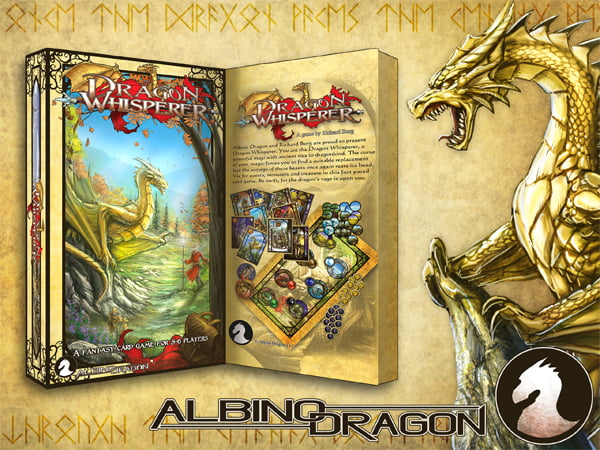
If you’d like to see the result of one of these licensing endeavors, check out Dragon Whisperer. We licensed the game mechanics from the legendary game designer Richard Borg and crafted a rich and vibrant world around them that we’re really proud of.
—
Erik Dahlman is CEO of Albino Dragon, a game publisher based in Austin, TX. Within the past year, Albino Dragon has launched and successfully funded five Kickstarter projects that have raised over $180,000 to date by leveraging licenses ranging from Richard Borg’s game mechanics to Chaosium’s Call of Cthulhu. An avid gamer and businessman, Erik strives to maintain transparency with Albino Dragon in an effort to help others also realize success in the industry and give back to the community.
The TARDIS Little Free Library is a big hit in the neighborhood. We’ve been interviewed by the neighborhood newsletter editor. We’ve received a number of donated books (pictured) and a whole lot of compliments.

The most surprising thing about our little free library is the fact that so many in the neighborhood immediately assumed that if they took a book, they needed to add a book. I had to explain to a few that, no, all they had to do was take a book and return it when they were done. It was like a normal library… just without a librarian.
The next surprise was the number of neighborhood people who came by to add books to the library. I don’t even know how many books were added because other people in the neighborhood snapped them up. It’s pretty cool to see how the community is working together over a love of reading.
Which was exactly what the Husband and I wanted to promote.
Currently, we have a request for more middle grade books and, in specific, a request for “Magic Tree House” books and “Jason and the Argonauts” books. If you’d like to donate any books, please send the books to the address below. All donors are listed on the TARDIS Little Free Library website.
TARDIS Little Free Library
C/O Jennifer Brozek
6830 NE Bothell Way, STE C #404
Kenmore, WA 98028
Finally, because some people have asked, if you would like to donate money instead of books, please send your donation via Paypal to gaaneden at gmaildotcom. Otherwise, we can accept check and cash to the above address.
LEGO Friends hit stores in January 2012. By then there had already been weeks of arguments online: is pink good for girls? These are dolls not building blocks! Who’s going to play with them?
Olivia, the main Friend, has an inventor’s workshop. I looked at that little LEGO lab and I knew she had adventures in the offing. I knew she had a love of real science and that she was going to grow from a young tinkerer to an adult engineer.
From my own experience in science and technology, I understand the importance of role models. I wanted to kick down the door LEGO left partially open by giving Olivia a hobby that was nearly masculine. I wanted to subvert the stereotype of science and make it something okay for a girl to love. While I may personally dislike pink, it doesn’t matter the color of your oscilloscope. If you want to work with one, you want to work with one. If the color makes you stop and get interested, then good.
So I went to Kickstarter and some wonderful backers supported my project that twisted stereotypes about scientists and throw open the field for people who enjoy pastels. I wanted to write about how collaboration between adult scientists has its roots in being, and staying, friends. I wanted to be gleefully and unashamedly in love with the cool aspects of science, giddy about electrons and x-rays. I wanted to showcase the women working in science, both today and in the past. And I wanted to build telescopes and x-ray machines and microscopes out of LEGO and show Olivia using them.
Thanks to my backers, the stories are out there for anyone to purchase. Each one includes a color picture of Olivia, often with her friends, using computers and lab apparatus. She’s got a whiteboard and a blackboard and she’s not afraid of putting up equations.
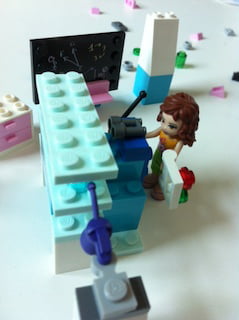
Subvert scientist stereotypes by supporting stories of Olivia the Inventor as she recreates some of the grand experiments of science.
—
Mary Alexandra Agner writes of dead women, telescopes, and secrets in poetry, prose, and Ada. As a freelance science writer, she’s worked with Under the Microscope, Argonne National Laboratory, and other markets. Her latest book of science poetry is available from Parallel Press. She was born in a United State made for lovers and currently lives halfway up Spring Hill. Her advanced degrees include Earth & planetary science and creative writing. She can be found online at http://www.pantoum.org.
Blown away.
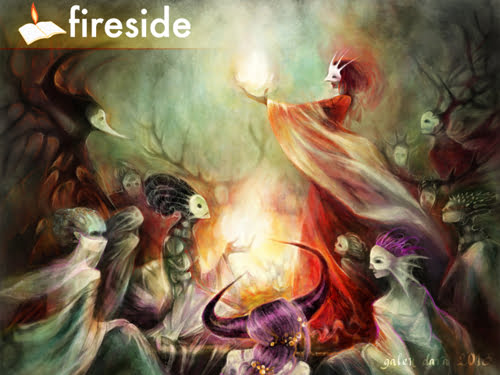
That’s how I feel every time a story or a piece of artwork arrives in my inbox for Fireside, my multigenre fiction magazine. We’ve been publishing for a year now, and you’d think I’d be used to it, these sparks of brilliance (like the gorgeous fire scene Galen Dara did for our current Kickstarter pictured below). I think maybe that’s a sign of good art, that no matter how much you’ve read or how many pictures you’ve looked at, when something is beautiful, or powerful, or whatever it is that is grabbing you by the soul, you can’t help but be moved. And I’ve been lucky to have found so many brilliant people to work with on this magazine, people who get what we’re trying to do: tell great stories.
Before I launched Fireside, I had all these ideas: focusing on storytelling rather than genre, paying creators fairly, experimenting with crowdfunding. Then came all the work: finding writers and artists, figuring out how to write contracts, putting together the Kickstarter, running the Kickstarter, succeeding in the Kickstarter (WHEE!). Then I waited, because the deal I had with everyone was that they’d write and create the art only if the Kickstarter succeeded. I didn’t want people doing work they wouldn’t get paid for, if the Kickstarter failed. It was a gamble, I guess, since I didn’t know what the stories were going to be, and I was locked in with the writers I had signed up. What would I do if I got a bunch of stuff I hated?
One morning a few weeks later the little (1) appeared next to my email Inbox. It was from Ken Liu, and his story for Issue One, “To the Moon,” was attached. It was the first story I got to read for Fireside.
It was wonderful. And I knew everything was going to be OK.
Fireside is a lot of work, especially running Kickstarter campaigns. We had a Kickstarter for each of the three issues we published last year, and today we’re launching a new one, to fund an entire year of a totally revamped monthly magazine. We’re hoping to put Fireside on a more stable footing. It will still be a lot of work, but it also means even more magic in my email. And then I get to share it with the world. And I hope the world, or the tiny slice of it that we reach, anyway, has one feeling when we arrive every month:
Blown away.
—
Brian White’s day job – well it’s really a night job – is as a newspaper copy editor. He has a healthy obsession with bourbon and fedoras. Brian lives in the Boston area with his wife, Lauren, and two cats: Bast and Peep. Find out more about Fireside magazine at its website or on twitter: @firesidemag.