Get a free story when you subscribe


On July 23rd, the day that Hugo voting closes, I posted on social media that “Less than six hours left before we all become Schrödinger’s Hugo award winners. Either we have already won or lost.” This is the period between the end of voting and the announcement of the winners. During that liminal time, we are both Hugo winners and Hugo losers.
I’ve used my Hugo nomination to treat myself to some things I don’t normally buy (a couple gowns, some jewelry, a tiara…), but I kept thinking about that phrase “Schrödinger’s Hugo winner.” So, I decided to support one of my favorite artists, Alina Pete, and commissioned some artwork at Gen*Con.

Isn’t he the best? Now, I will always have “Schrödinger’s Hugo winner cat” on my wall. I’m also gifting it to all of the Hugo Award 2025 finalists (as well as future Hugo finalists when they, too, become “Schrödinger’s Hugo winner”) to be amused by.
You may use the image for blogposts and such as long as you credit the artist, Alina Pete (alinapete.bsky.social or https://linktr.ee/alinapete) on the post.
Sometimes, you just have to treat yourself like you would your best friend.

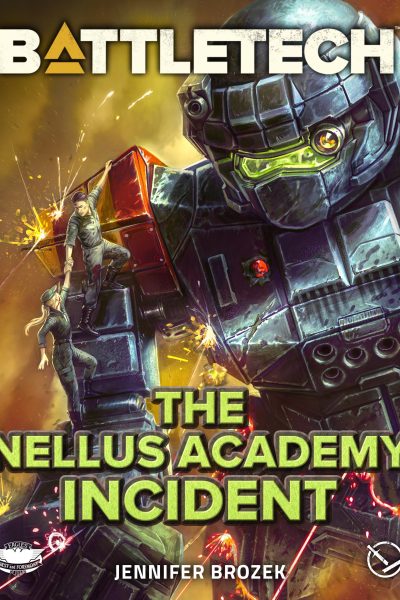
It’s been five years since I stepped into the BattleTech arena as a writer. Over ten since I wrote my award winning YA BattleTech novel, The Nellus Academy Incident. I’ve never written a one-off BattleTech short story. Now I’ve written two…and one of them is currently available for free on the Catalyst Game Labs “free download” page.
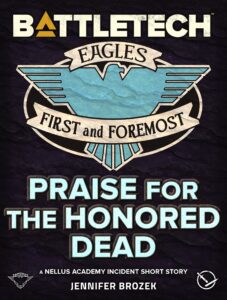
For August only, “Praise for the Honored Dead” is available for free, and it takes place after about a week after the events of The Nellus Academy Incident, and thus will have many spoilers for the novel. Gotta admit, I’m in love with the cover of this short story.
“GET READY FOR THE WORST TIME OF YOUR LIVES.”
The press is calling it “The Nellus Academy Incident.” For the cadets that fought against and survived a brutal mercenary assault intended to spark a war between the Free Worlds League and the Lyran Alliance, it was only the beginning.
Now, they must navigate the gauntlet of appearing in public…and dealing with what happened on Phobos. Barely days past risking their lives—and seeing their fellow classmates sacrifice themselves for the others—the four remaining cadets must come to terms with what has happened…and lay their friends to rest while under the pitiless glare of government cameras that record their every move…
Rereading The Nellus Academy Incident more than 10 years after I wrote it was interesting. I had some genuine moments of “Oh, that’s good” and “Damn, I don’t remember writing that. It really works.” Of course, I had a couple moments of “I could’ve written that better.” But not many.
It was like bumping into an old friend after a long absence and realizing, yeah, they were cool and you’re glad you know they and met up again. There is joy in realizing that, yeah, you do do good work. I hope you enjoy returning to the Nellus Academy for a brief dip back into the cadets’ lives.
Two years ago, I contacted Rem from Rem Alternis and asked her if we could meet at Gen Con to talk about having her company run the Kickstarter for a passion project I wanted to create. We met. We agreed to everything. And ran the Kickstarter in March of 2024. It funded and as of July 27, 2025, that Kickstarter is over, done, and things involving it mailed/fulfilled.
Dear Penpal, Belgium 1980 was quite the endeavor—telling a MG horror story over a year in 24 physical letters. Yep. If I’m gonna do a Kickstarter, let’s do it on Hard Mode. Next time, if there is one, I’ll do something easy like a novella series. I don’t regret doing Dear Penpal, but I won’t do it this way again.
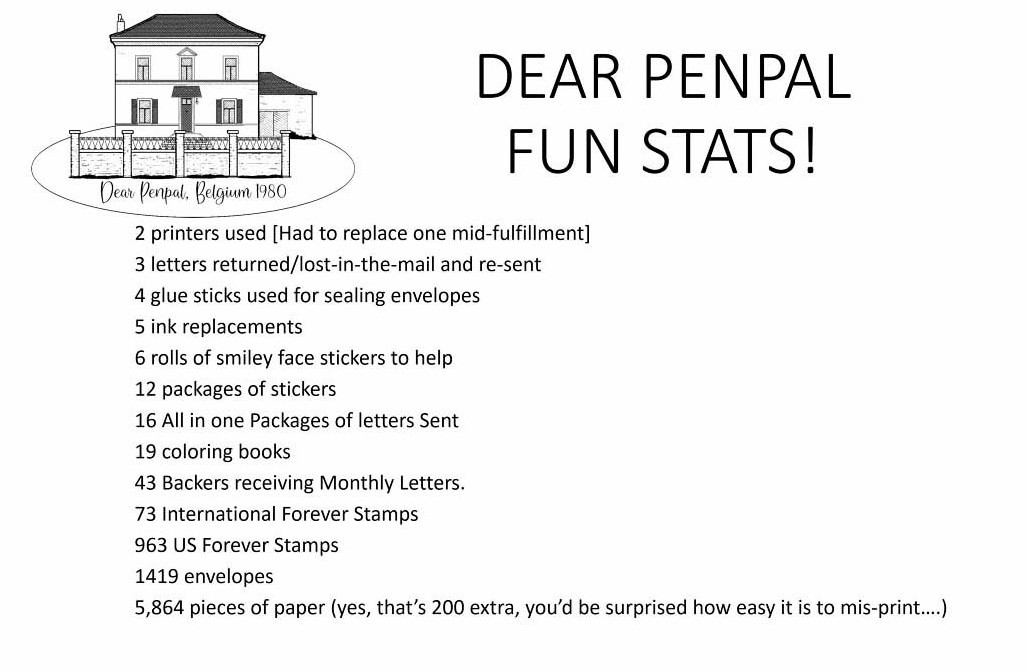
Here’s some fun facts the Husband put together for the celebration party. I thought they were too good not to share.
So, the final question that has been asked of me… “Will there be any more Dear Penpal stories?”
The answer is maybe. I’ve got an idea for a series of novellas around it. 3-4 more in the series, jumping years in-between each one. Each one would still be in letters. Probably 2 each month, but put together as a novella. This is a nascent idea, kicking around the different places I’ve moved to and interesting things that could’ve happened to fictional Jennifer who can see ghosts: Pennsylvania 1984 (teen), California 1989 (senior in HS), Oregon 1992 (college), Washington 2004 (adult).
Yeah. Maybe. If the idea still calls to me next year, I might chase it down. We’ll see.
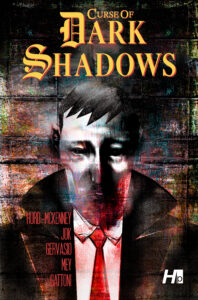
During the pandemic, I was in a comics writing group. I was convinced we’d all be dead and there would be no more conventions. Conversations turned, as they inevitably do, to the franchises we’d love to take a crack at. I have always encouraged creators to focus on their own ideas more so than other IP, so I dreaded the conversation getting to my turn. And when it did, I began to answer (shocking myself even): it was Dark Shadows.
You see, I’d also been rewatching Dark Shadows (the entire 1225 episode catalogue) during the pandemic. If it was all going to be over, what better family to go out with than the Collins family of Collinsport, Maine? So as I began to answer the IP question, the idea for the story sprang, fully formed, into my mind. That very rarely happens for me as a writer.
No spoilers here, but thematically, inspiration can be found in WE HAVE ALWAYS LIVED IN THE CASTLE by Shirley Jackson.
There’s Truman Capote and Harper Lee and William Faulkner all in there, too, but all good Dark Shadows storylines were based on some classic fiction. So my approach would be Southern Gothic, channeling my own lived experience and my fractured family ties into a story about the Collins family. Why Southern Gothic? It’s hallmarks: dilapidated mansions, deeply flawed humans usually entrapped in a generations-long family feud, and the sinister events which arise from all of the above. If you know Dark Shadows, then you can see the connections.
I do feel connected to Dark Shadows. My mother would race home from school to watch when the show was originally airing. I haven’t spoken to her in almost 15 years, thus this project was an incredibly healing one. I found the resolution I won’t find in this life. I’m at peace with that. We never discussed Dark Shadows when I was a child. I knew she liked it. While we shared a love of the show, what could have perhaps made us closer never did. But in watching the show in its entirety, I felt that I was able to make a relationship with it (the show) separate from her, and also resolve some of our conflict for myself in writing this new chapter of the show.
So here we are, almost three years later from the comics Discord discussion, and the book is coming out soon. There’s a short and sweet story behind my entrance into the officially licensed world of Dark Shadows, but I’ll save that one for another dark and stormy night.
—
Craig Hurd-McKenney is a Xeric grant recipient and Ignatz-nominated comic book writer living in Seattle, WA. He has been making comics since 2000. For more information about Craig, please visit: https://www.hspcomix.com/
 Answering the question of WHY DO I WRITE? (something I encourage all writers to do), I have concluded that my WHY is this: I write to tell stories about underrepresented people and underrepresented places in a way that is accessible, and hopefully, entertaining.
The underrepresented place I most often write about is Saskatchewan, my home province. The underrepresented people I most often write about are members of the LGBTQ+ community. The combination of the two is, I feel, truly underrepresented and rarely found in Canadian mystery genre material.
As a writer writing about LGBTQ+ characters, I have on occasion encountered people, usually interviewers or reviewers understandably looking for an angle, decide that I am the spokesperson for that community. They are mistaken. I am one person, one voice. Deciding I am the spokesperson for the LGBTQ+ community is like a Martian, freshly landed on earth, deciding I am the spokesperson for all humans.
That being said, as a mystery writer who is a member of, and advocate for, the LGBTQ+ community, my hope is that my singular voice, my presence and representation in the publishing industry, encourages more voices to speak out and helps to move the community out of the category of being underrepresented.
Even so, I have found you cannot please everyone, outside or even inside your own community.
I was fortunate to find a publisher for my first book without agent representation. I was about 4-5 books into my first mystery series when I received a letter from a graduate student completing his Master’s thesis at Carleton University. I was quite surprised—and I must admit, rather flattered—to learn that the subject of his thesis was my Russell Quant series.
He sent me a copy of the abstract which, in part, read…now, keep in mind the series has a main character who is gay:
“With Russell Quant, Bidulka has shifted the originally well-defined, straight-forward, stolidly masculine identity of the hard boiled, urban crime-fighting hero to a marginal landscape, where subversion, introspection, and humour reign.
“In this paper, I contend that Bidulka’s writing queers not only for the detective fiction genre, but also the regional landscape that his imagined communities inhabit, and myths of Canadian nationhood that bind them.”
Making no claim of being a great academic or literary scholar, I readily admit I didn’t really understand most of the abstract’s claims—but it sounded pretty good.
Some months later, this same grad student sent me a copy of his now published thesis. Once again, this was a high-minded, rather lengthy, scholarly document, but I was smart enough to recognize that in slow methodical fashion this student had deconstructed every book in the series and then completely tore them to shreds for:
“carelessly giving voice to the “homonormalization of the entire lesbian and gay community in Canada today.”
So, yup, if you were wondering, that was me. I did that to the entire LGBTQ+ community in Canada.
Lesson learned. You can’t please everyone all of the time. But—and here’s where light comes from dark—about a year later, this same graduate student was delivering his paper at a conference in California. In the audience that day was another gentleman who, for some inexplicable reason, after hearing the same conclusion noted above, felt compelled to read my books. And today, that gentleman is my literary agent.
—
Anthony Bidulka’s books have been shortlisted for Crime Writers of Canada Awards of Excellence, Saskatchewan Book Awards, a ReLit award, and Lambda Literary Awards. Flight of Aquavit was awarded the Lambda Literary Award for Best Men’s Mystery, making Bidulka the first Canadian to win in that category. In 2023, in addition to being shortlisted for a Saskatchewan Book Award and Alberta Book Publishing Award, Going to Beautiful won an Independent Publisher Book Award being named Gold Medalist as the 2023 Canada West Best Overall Fiction novel and was awarded the Crime Writers of Canada Award of Excellence as Canada’s Best Crime Novel for 2023. https://anthonybidulka.com/
 Mourning a Life that Never Was
When we’re young, we believe we have complete control over our lives. Everything we dream of achieving will happen, if for no other reason than we want it. We’re told good people are rewarded, so as long as we’re good, we’ll get the life we deserve.
But that isn’t how the universe works. At the age of nine, I decided I was going to be a ballet dancer. But after fifteen years of lessons, I finally had to accept that I had neither the talent nor the body required to dance professionally.
Years later, I was introduced to the concept of grieving non-events, also called non-finite grief, the grieving of things desired but never achieved. My disappointment and resentment now had a name.
It’s hard to accept that we’ve been denied the life we so desperately want. Valentine’s Day and Mother’s and Father’s Days come around every year to remind us that we are alone and/or childless, and how unfair it is that everyone else seems to be celebrating what we can’t.
While friends and family might be inclined to tell us to buck up and get over it, it’s not that simple. We have to go through a grieving process as painful as the loss of a loved one, because we have lost a loved one. We’ve lost that part of ourselves that was going to be a parent or homeowner, marine biologist or dancer.
In A Dark Death, the second book in my Meredith Island Mystery series, my amateur sleuth, Kate Galway, shares with her best friend her dream of becoming a university professor. “I had a whole different life planned out for myself. I was going to get my doctorate and teach English to people who not only knew George Eliot was a woman, but had read all her books and could discuss them with some reasonable degree of insight.” But while finishing her Master’s degree, Kate became pregnant. When her daughter was born, she gave up her graduate studies and taught high school to help support her family. Not becoming a university professor is Kate’s non-event.
Instead of moving on, Kate has held onto her grief for almost thirty years. In her mind, she settled for a career which is second-best, and therefore she is second-best. Those who can’t do, teach, and those who can’t teach university, teach spotty, moody adolescents, she believes.
When she meets a visiting archaeology professor, Kate learns about the often ruthless competition and politics of the job. “It isn’t all Jane Austen conferences, believe me,” she is cautioned. Later, her friend tells her that there is no guarantee she would have been happy teaching university, and that she could just as easily have spent her life wishing she’d taken a high school job instead. It’s then that Kate realizes that the perfect life she envisioned is a fantasy, and she can begin to heal.
How do people grieve their lost selves? “Grieving the Life You Expected: Non-finite Grief and Loss,” posted on the What’s Your Grief website, lists some actions you can take. These are my favourites. I hope they help.
—
Alice Fitzpatrick has contributed various short stories to literary magazines and anthologies and has recently retired from teaching in order to devote herself to writing full-time. She is a fearless champion of singing, cats, all things Welsh, and the Oxford comma. Her summers spent with her Welsh family in Pembrokeshire inspired the creation of Meredith Island. The traditional mystery appeals to her keen interest in psychology as she is intrigued by what makes seemingly ordinary people commit murder. Alice lives in Toronto but dreams of a cottage on the Welsh coast. To learn more about Alice and her writing, please visit her website at www.alicefitzpatrick.com.
The 2025 Hugo Award voting closes in 36 days (July 23).
I debated on whether or not I would post this because of reasons (everything going on in the world and more), but as an editor/seminar instructor, I frequently instruct my students/authors not to self-reject. Their job is to do the thing. My job (and the job of all editors out there) is to see if the thing fits what they need. “Don’t do my job for me,” I say.
“Physician, heal thyself.” Or, in other words, “Editor, take your own counsel.” Thus, here I am.
What would a Hugo win mean to me and for my career?
Career: I have not (yet) won a Hugo award. I would really like to. For many reasons. But, I think, most of all, it would help my publishing career. Already the second nomination has allowed me to land a freelance job I wanted at a per hour rate my skills are worth. This is huge for me.
The Husband no longer works in tech. In fact, he’s just been accepted into UW’s graduate program for a Masters in Library and Information Sciences (MLIS). I am so proud of him. However, this means he has school for the next two years, and money will be tight. I need/want my publishing career to continue to level up.
Personal: As an editor, I have been nominated for the Bram Stoker, the British Fantasy, and multiple Hugo awards. While it is an honor (no, really, it really-really is), I would love to win one. Much like qualifying for HWA, IAMTW, and SFWA, it is one of those publishing career goals/milestones. For those in the know, it is an immediate reputation boost. Even outside the publishing industry, many people know what a Hugo is.
Emotional: In my blog post, The Second Nomination is the Best, I mentioned that I burst into tears when I read the email telling me that I was a finalist again. There was relief in knowing the first time wasn’t a mistake. It’s been a joy to hear from people that they were glad to see me on the ballot again.
I think winning a Hugo at a Seattle Worldcon would be the best. It would make me feel like “Hometown Girl Does Good.” There would be relief in finally winning one of the “big ones.” It wouldn’t matter if I was never nominated again. (Of course it would matter, but maybe not as much…)
Is a Hugo win a guarantee to a better publishing career? No. But it can’t hurt. (Unless someone stabs me with it—and what a way to go out!) Do I want to give an awards speech? Absolutely. Do I want to hold the Hugo trophy in my hot little hands and flush like I’ve been drinking all night? You betcha. Do I want to let Seanan put mantises on my head? I’m a little iffy on this one, but I did promise to let her do it if I won (a promise made before I was nominated, and I’m a woman who keeps her promises). Besides, Paul said he’d take pictures, and he takes a really good picture.
 Why I was Afraid to Engage with the News
Sometimes I worry that reading the news is above my paygrade, or that I’m being pushed to believe that it is.
Here’s an example: I was reading articles about Trump’s invasion rhetoric, then was surprised when it suddenly stopped. Our then provisional, now permanent PM called him, reporters said. Whatever happened in that phone call convinced him to lay off the 51st state threats, they said. Carney was a banker. He understands financial levers. He probably threatened something to do with bonds. That makes sense, I said in subsequent conversations with friends, although it didn’t really make sense to me. I’ll level with you. I don’t know that much about bonds. I certainly don’t know anything about global financial levers. I started by looking up the terms. The AI loaded without my consent on all my devices chimed in, offering to help, to explain, to summarize the hard stuff for me.
I’m concerned about environmental costs of AI. I’m worried about errors and hallucinations, too. But, I have to admit, I was so overwhelmed that I considered taking it up on its offer. But then I paused.
Reading is more involved than just unlocking words. Reading comprehension, real understanding, means figuring out context too. Reading well requires deep dives.
How I Almost Ruined Reading Ten Years Ago
Let’s rewind a decade. When my son was little, I worked at night so that I could be with him during the day.
The days themselves were joyful, fun, frenetic and fast moving. We went to park to class to park together, and as we walked from place to place, he pointed at signs and asked me to read them to him. I loved those times because they gave me a bit of a breather too. He pointed, I read out mechanically, and I let my thoughts wander. Eventually, he started pointing and telling me what was written on all the signs. I remember looking down at him in wonder: he’d memorized some but was audibly sounding out others. It became clear that he was teaching himself to read this way.
Cool, I thought. I then consulted parenting books just to make sure. Not cool, said the manuals. Parents shouldn’t teach reading haphazardly, or they run the risk of confusing their kids. They should have a plan. OK, I thought. I could do that.
The books themselves didn’t agree with what I was doing, but they didn’t agree with each other either, so formulating a plan was rough. Kids should learn to read by being presented with books, said some, like some kind of literary osmosis. Kids should learn by sounding out words. Kids should learn with phonics, or flash cards, or diphones. I went out and tried it all. My child is a sweetheart and put up with all of it, all the while still asking me questions and teaching himself to read on his own, in his own time, thank goodness.
The one thing all the parenting books did agree on was that I shouldn’t just teach decoding words, that I should teach him to read to understand context and subtext and to read between the lines as well. That required background information. That was advice that I could get behind, and not only because it seemed harder to make a mess out of than reading itself.
The books’ advice, everyone’s advice, was to read as much as you could to your child, as widely as you could, and present as much material as possible. Dive into as many subjects as you can. Dive often, and dive deep. That’s the guidance that I remember most from that period.
I also recognized that it was advice that was relevant to my own life. When I read the news, I remembered, I often worried that I was missing stuff. The more info you have, the books all pointed out, the more you can read between the lines. Be sure to fill yourselves with information. This, I realized, meant me too.
How I Live the Deep Dive Method
Luckily, my child has loved this strategy. He’s a deep diver by nature. He’s one of the completist kids for whom “collect them all” makes sense and becomes a fun and hilarious life mission.
Plays, books and TV shows have become fun entry points. We saw The Three Sisters by Inua Ellams, a phenomenal adaptation of The Three Sisters set in Nigeria during the Biafran War, and we took deep dives into Nigerian history. My son read Time Atlas by Robert Hegarty and History as It Happened: A Map by Map Guide published by DK. His parents are reading The Fortunes of Africa by Martin Meredith and How Europe Underdeveloped Africa by Walter Rooney. We watched Young Sheldon and have been reading entries into the world of Physics like The Elegant Universe by Brian Green and Astrophysics for Young People in a Hurry by Neil DeGrasse Tyson. Sometimes questions inspire other questions, and sometimes missions just materialize. We’ve been reading about code breaking during the second world war, the history of video game consoles, the history of US elections, the history of all of soccer, and all histories and timelines of all Zelda games, to name a few deep dives.
My son lets experiences inspire him, and, when he has a question, he works to answer it completely. I’m so inspired by that. I’m trying to live that way too.
I took a deep dive into the Chernobyl nuclear accident, and that inspired a whole novel. I’ve read a ton about the Covid epidemic and climate change and children’s development, and those deep dives are inspiring the next one. I’m trying to do it more often. I’m trying to do it more widely. When I have a question, I try to find a way to dive deep.
Deep Dive with Me
I’m still fighting through the news. I want to understand this situation that we’re all in, and I’m not going to ask an AI copilot to do it for me.
So even though it scares me, I’m learning about economics. I’m reading The Ascent of Money by Niall Ferguson and Dr. Strangelove’s Game by Paul Strathern. Those books have led to other questions, so I’m also reading about the Russia-Ukraine conflict, the life of Ignaz Semmelweis, the history of asbestos, etc. I’m also reading about the French Revolution. Maybe I’m going back too far. Maybe I’m filling gaps that I shouldn’t have had before. I’ll level with you again. There are gaps in my knowledge, and I’m afraid they might be nig ones.
I’m going on more deep dives besides. I’m getting in on dives with friends. I have a friend interested in music, so I’m reading The World in Six Songs and I Heard There was a Secret Chord by Daniel Levitin.
I’m enjoying the process. I’m getting in on friends’ deep dives. I’m giving myself the confidence that even if I’m doing it imperfectly, even if I don’t understand every little thing, I’m engaging in the news and world events, and I’m protecting my organic intelligence.
—
Alexis von Konigslow is the author of The Capacity for Infinite Happiness. She has degrees in mathematical physics from Queen’s University and creative writing from the University of Guelph. She lives in Toronto with her family.