Get a free story when you subscribe



Writing and editing continue. There’s so much to do. Must word faster. If I stop, the words will eat me. Here’s a Bubble & Squeek for you.
eBay and Signed Books: If you would like signed books from me for yourself or as gifts, we have a bunch of my books up on eBay. This will remain on eBay until all of my books are gone. All money goes to me.
Open Call: I have an open call on Flash Fiction Online. Theme: Tiny Gods. Blind submissions, submission window is Mar 1-31.
Podcast: Staying Optimistic in Dark Times by Skiffy and Fanty, guest starring me. Me and whimsy are good friends these days. It’s either that or depression.
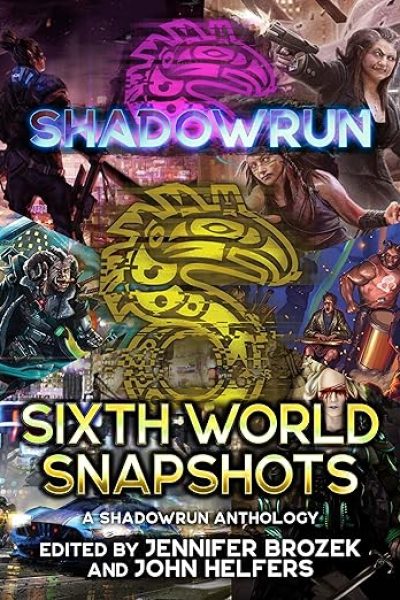
Release: My 27th edited anthology, Shadowrun: Sixth World Snapshots anthology, has now been released!
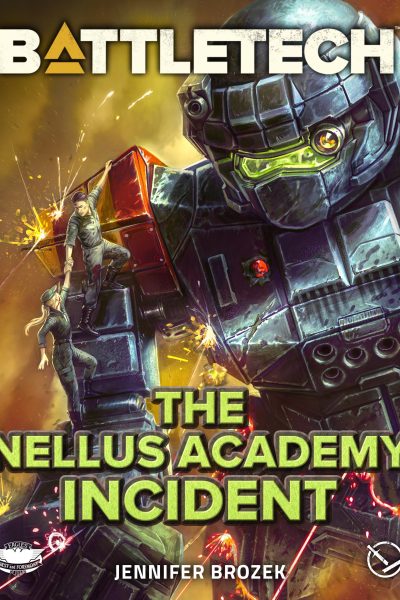
Release: “Praise for the Honored Dead,” one of my two companion BattleTech stories to The Nellus Academy Incident, has been released in the BattleTech: Tales of the Inner Sphere anthology!
Release: The Waterborne anthology is live! This anthology has my story “On Risks and Rewards” which is the other side of the story that’s in the Skull X Bones anthology called “More than Blood in the Water.” It’s always nice when I share a TOC with Seanan McGuire and Johnathan Maberry.

Support: As always… if you appreciate my work and would like to support me, I love coffee. I am made of caffeine. This is the quickest way to brighten my day.
 Lucky 13. That’s how many times I had to submit my novella, Between the Stars I Found Her, before it found a home.
At the 2018 Worldcon (San Jose), I attended a mentoring session hosted by the Science Fiction & Fantasy Writers Association (SFWA). I was paired with Julia Rios, a talented writer/editor who managed Worlds of Possibility. She heard my pitch about two projects I was considering: a second-world fantasy based on ancient Yemen, and a science fiction story set in a socialist paradise that included cloning and personality transfers (i.e., functional immortality).
Julie said I showed more interest in the second idea and encouraged me to pursue it. She was right.
The result was a novella, Between the Stars I Found Her. My POV character is Mylene Vandenberg, whose ex-wife commits suicide. I wanted to explore themes of grief and loss, especially when the concept of true death had become rare.
The story really clicked for me when I put Mylene on a solo journey that takes her far from Earth. She and her ship, The Flying Dutchman, stumble across the corpse of an astronaut lost over a century before. That gave me the opening to play around with several puzzles—who was this person? How did their life pod get into deep space?
The answers could lead Mylene back to Earth. Full circle, as it were.
Easier said than done, certainly. The draft became a story which was rejected several times. I kept at it. My helpful critic group correctly pointed out that the story was too short (and boy were they right), so the story grew into a novella. It was rejected again. And again.
On the thirteenth submission, I found an editor (Mark Bilsborough at Wyldblood) who liked it enough to help me develop Between into a proper novella. Mark had published several of my flash fiction stories and I was happy to work with him again.
The novella’s journey wasn’t an easy one, I’ll be honest. Writing Between the Stars forced me to do research and—Gods forbid—write a real outline rather than simply banging at the keyboard for a few thousand words and call it a draft.
There was also Mundane Reality™ that many writers face: jobs and family and COVID, etc. Somehow, though, it all came together in a shiny wrap-around cover that you can hold in your hand. Imagine that.
In retrospect, I’ve learned a few important lessons. First, my idea for a secondary world fantasy novella/novel wasn’t bad, but I was trying to write something I thought would be popular (Everyone loves epic fantasy, right?) rather than telling a story that meant something to me. Bottom line: listen to your Muse. She knows the score.
Second, you have to back up your Muse with perseverance. And patience. The best stories sometimes take years to find the right editor, the right agent, the right publisher. And even if they do, shit happens. (Buy me a cup of tea and I’ll tell you all about it.)
I’ve often remarked to friends that I hesitate to write longer stories because I’m not willing to let the characters live in my head for at least two years. Well, Mylene lived in my head much longer than that and I still like her a lot.
—
Karl Dandenell is a graduate of Viable Paradise and a Full Member of the Science Fiction & Fantasy Writers Association. He and his family, plus their feline overlords, live on an island near San Francisco famous for its Victorian architecture and low-speed traffic. Karl has published over 50 works of short fiction in the United States, Canada, and Great Britain. Follow his occasional posts at Bluesky (@karldandenell.bsky.social) and read more about of his fiction at www.firewombats.com.
At the end of 2025, I burned out hard. I took 10 days off before my body and mind forced me to take a rest (this latter is always the worse option). Honestly, I could use another couple of weeks of doing nothing. Not going to happen. However, I do feel a lot better, calmer, and more ready to face the work world again.
So, 2026. I don’t do resolutions. I haven’t for years. I usually don’t do yearly themes. I’ve never needed them. But, I think this year, I do. My theme for 2026 is “Be present for yourself.” I spent a lot of the last couple of years working for/looking out for other people. I’ve made attempts to keep myself in mind, but *I* was always the easiest ball to drop when things got hectic. My writing goals, my physical goals, my wants/wishes/needs.
I’ve got to figure out how to stop putting myself last. It’s getting me in trouble. My novel, Shadowrun: Imre Grey, isn’t done and it should be. I’m barely holding onto my diet goals, and my movement goals are down to squats and wall pushups in-between other things. Thus, I guess that means I need to actually, physically, schedule movement into my week.
The other thing I am going to do is plan in quarters this year. I’ve been doing this for a long time in my head, but not on paper. This time, in order to be more present in my own life, I need to stop looking so far ahead that I can’t see the deadlines in front of my face.
1st Quarter (Jan-Feb-Mar). In addition to keeping my CGL lines running, I have two main projects:
2nd Quarter (Apr-May-Jun). In addition to keeping my CGL lines running, I have a single project focus:
I will worry about the 3rd and 4th quarters when I get there. Especially since convention season really starts in June.
* * *
On the Homefront, I have three new specific desires this year: Daily Journal, Comfort Reading, and Tranquil Thursdays.

That’s the plan for 2026: Quarterly project goals and showing up for myself more. As always, I will keep track of my metrics. (If you would like a copy of my blank 2026 Freelancer Summary document, contact me. I will send it to you.)
Tis the season! Whamageddon is upon us.

And should you fall…

We shall die and dine together…

Remember, this is all in good fun. Don’t be a jerk, and don’t yuck on someone else’s yum.
 Most of my writing career has been spent in long form novels set in the grim and perilous worlds of Warhammer, but I often like to venture beyond that into other forms of writing, genres, and tones for variety and texture. What I mean by that is I need to feel like I’m exercising different writerly muscles when I embark on different projects, whether it’s a novel, a comic, a short story, a screenplay, or whatever. I feel this is good for me and the reader, as it helps keep things new and exciting. It means that when I return to each different genre or project type, I’m enthused to explore it again and not likely to get pigeonholed into one corner. Likewise, as a reader, I like to vary my diet of books between SF, Fantasy, Horror, Crime, Non-Fiction, etc., so I don’t ever get tired of one genre or writer.
The reason I do this with my writing is that each project employs different sensibilities and creative choices, whether it’s the discipline of the word count in a short story, where you want to get in and out of Dodge with speed and clarity, or a novel where you can afford multiple sub-plots and be (a little) more self-indulgent. Then you have screenplays, which have a very definitive structure and format, where all the emphasis is on the dialogue and providing a ‘blueprint’ for the folk who have to shoot what you’ve written. When it comes to comics, I love working with an artist to bring the words on the page to life and leaning on their talents for how to lay out the page. With comics, you also have the fun challenge of pacing the story in such a way that the big reveals, splash pages, and so on all come at the right time on the reader’s page turns.
It’s the same with genre and mythologies, I love to mix and match or slam together wildly different origins to see what comes out. So, you’ll get books like Dead Sky, Black Sun, that fuse a grimdark SF tale with Barker-esque body horror, or A Thousand Sons, that’s a story of space wizards in a gothic tragedy of hubris.
That variety is what I had in mind when I first started developing the ideas for Wolves of Winter. I wanted to write an epic story of Viking warriors that ventured into magical and supernatural territory, which combined my love of various mythologies. As much as I love Roman, Greek, and Egyptian mythologies, I didn’t feel they were the right fit, and given that as a kid in Scotland, I’d grown up on stories of Celtic mythology, with its Kelpies, Selkies, and the Tuath Dé Danann, that seemed entirely appropriate a mash-up. Bringing the grand mythologies of the Norse and the Celts together allowed me to delve into both cultures in a way that felt real and authentic (and, most importantly, exciting!).
It’s my hope that, so long as I stay enthused for my craft by allowing for that blending of story types and genres I can keep entertaining my readers in exciting and unexpected ways for many years to come.
—
Graham McNeill is a Scottish, LA-based, award-winning, New York Times best-selling author, screenwriter, and games developer. Over the years, Graham has written for numerous global franchises, working on Riot’s League of Legends and on their Emmy-Award-winning Netflix show, Arcane; Games Workshop’s Warhammer and Horus Heresy settings; Blizzard Entertainment’s Starcraft universe, and the Dark Waters trilogy for Fantasy Flight Games Arkham Horror range. To date, Graham has penned forty-five novels, ninety-plus short stories, audio dramas, and comics. His novel, Empire, won the David Gemmell Legend Award for Best Fantasy Novel in 2010, and four of his novels in the Horus Heresy series have gone on to become New York Times best-sellers.
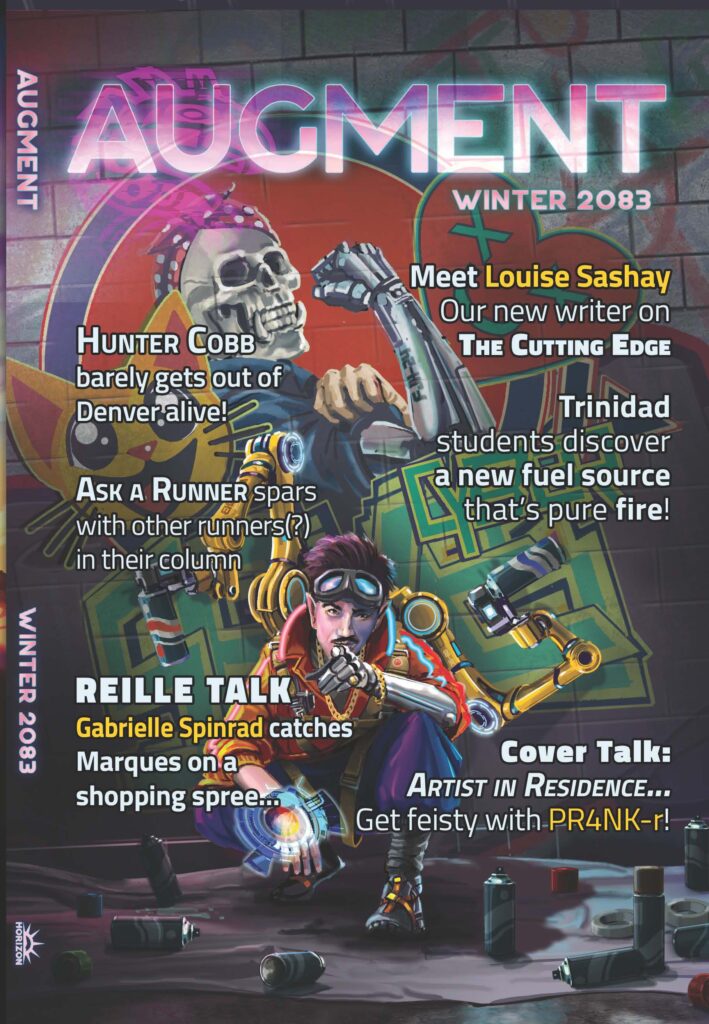
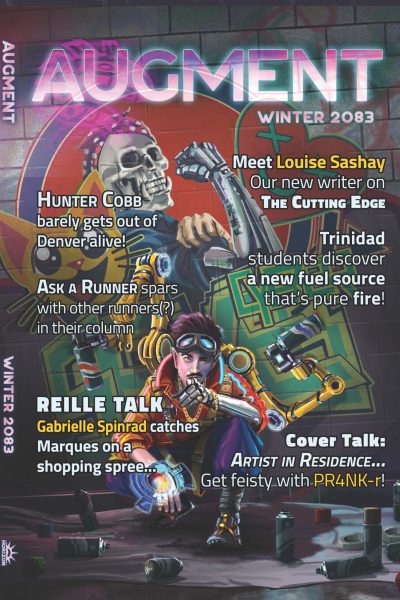
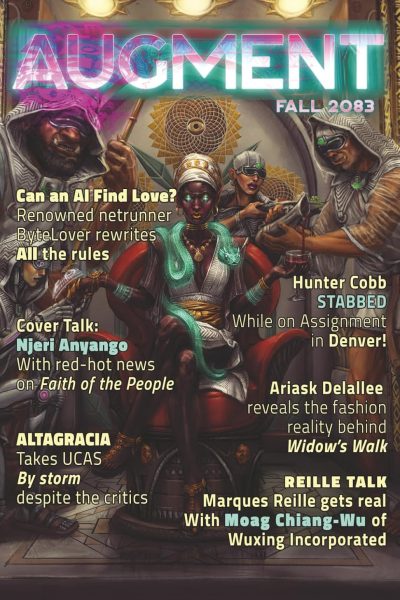
Augment is Shadowrun’s official magazine. This is a fully in-universe magazine, and can be used in Shadowrun games as well as enjoyed by the casual reader.
Augment, Winter 2083. In this issue about city life and vehicles, Leach tours around his hometown of Seattle to sample its delights. Marques Reille gets caught shopping in one of his favorite stores by none other than Gabrielle Spinrad! Yuta Nakata has a feisty interview with our cover artist, PR4NK-r, about art and life. Louise Sashey, new columnist of The Cutting Edge, spends time in Montreal and Kyoto, finding ways to experience city life in style. Enjoy these articles, reviews of new products, clothing, tech, and so much more!
Augment your life with Augment magazine!
Even the back cover is gorgeous!
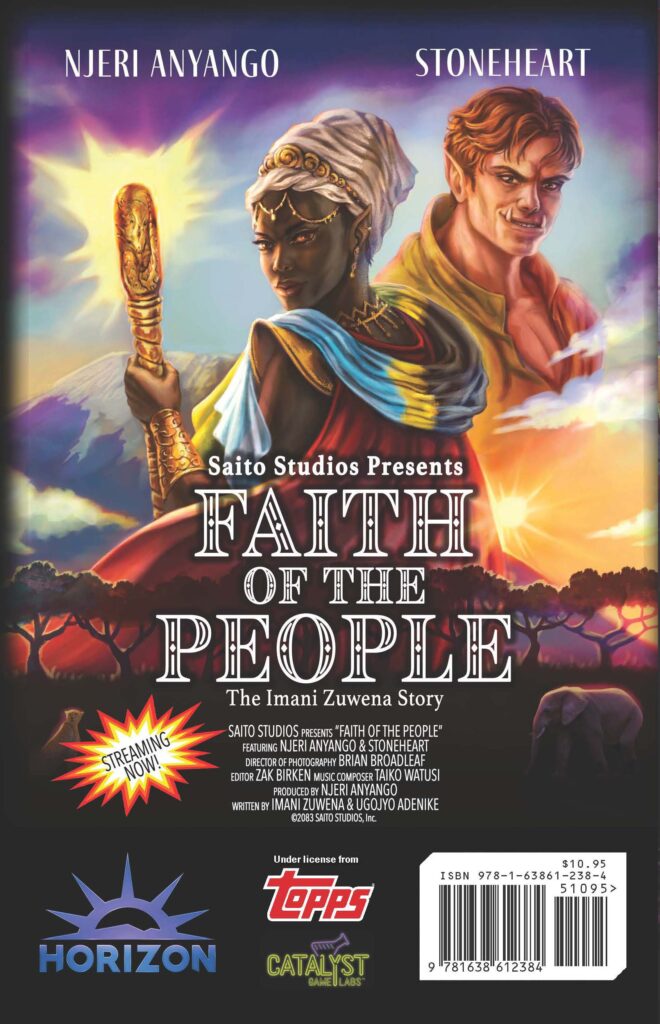
I had such a good time editing this magazine. It’s a ton of work but worth it. I hope you check it out. I’ll put pictures up of all four issues together when I get my hot little hands on them.