Get a free story when you subscribe


Shannon Page is an author I have worked with off and on for years. She’s a consummate professional and I’m really looking forward to reading this anthology.
—
On the Crafting of An Anthology

Witches, Stitches & Bitches—A Three Little Words anthology, from Evil Girlfriend Media.
Three little words…three simple, innocent—well, okay, maybe not so innocent—evocative words.
When Evil Girlfriend Media publisher Katie Cord asked me if I wanted to edit one of her “Three Little Words” anthologies, I jumped at the chance. I love editing, and hadn’t had much chance to do it professionally. Better still, she let me choose which of the three I wanted to take on. Now, nothing against zombies or vampires, but I knew at once that the witch book was the one for me.
I’ve always identified with witches. I was born on Halloween night, so people delighted in telling me I was a little witch before I even knew what that meant. Of course, I went through a period (like so many girls) when I’d have much rather been a fairy princess; but I eventually got over that and embraced my intrinsic witchiness. I’m writing a series of novels starring a young witch in San Francisco (the Nightcraft Quartet, which begins publication next year with The Queen and The Tower). Even my LiveJournal handle has the word “witch” in it.
So that was a natural. But stitches and bitches? Not as much of a connection there. That’s okay, I figured; let’s see what stories come in. I imagined needlepoint and revenge fantasies.
But wow! Authors are creative! (I know: not exactly earth-shattering news.) I got such a flood of marvelous stories filled with so much imagination, I looked forward to my email inbox every day. We had knitting and surgery and zombies stitching on new limbs. Devious and clever women; bitchy witches; female dogs. And we even had needlepoint and revenge fantasies—but nothing like what I’d imagined.
I received nearly three times as many stories as I needed to fill out the collection—not bad for the very first offering of a brand-new publishing company, paying nowhere near professional rates. I read every story that came in, even the ones where I could tell from the start that they weren’t a good fit. I wanted to see where each story ultimately ended up. I wanted to be surprised—and, a few times, I was. To me, a good anthology is like the perfect smorgasbord: a little of everything; something for everyone. That’s why I like more open-ended themes; they give the authors room to explore, to show off that marvelous creativity of theirs.
Then came the painful process: winnowing them down. I had to reject some really good stories, including stories from friends…including stories I’d specifically requested from friends. (Fortunately, my friends being good people, they forgave me.) But I knew I wanted to put together the strongest group of stories possible. I selected for length and tone and style and subject matter. I wanted balance, and variety. As I mention in the book’s introduction:
“The sixteen stories collected here range from light to dark, fun to disturbingly spooky, and everything in between. We have retellings of fairy tales, modern edgy fantasies, stories of delicious revenge. We have romance, and some broken hearts. We even have a few tales by male authors, just to be inclusive.”
And when all was said and done…I think we ended up with an awesome book. I hope my readers agree!


Growing up, my experiences in cemeteries were pretty limited. My mom took me and my brother to make gravestone rubbings only once when we were kids. My family sometimes visited the graves of famous people while on vacation: Kennedy in Arlington, George Washington at Mount Vernon. When I was in high school, I used to take dates to the little country graveyard up the road to park, but the mosquitoes were pretty fierce, so we didn’t get out of the car and explore.
It never really occurred to me that you could visit graveyards just for fun. Then my husband and I got stranded in London during the 1st Gulf War. We were heading to Barcelona to do sound for a Survival Research Laboratories performance, but airline security made us miss a couple of connections and we decided to stay in a country where we spoke the language until everything got sorted. Since this was in the days before cell phones, it wasn’t easy to call country to country back then.
I bought a book of cemetery photos at Victoria Station – because it was full of *beautiful* statuary. Inspired by that book, which I found by chance, my husband decided he’d rather see Highgate Cemetery than the Tower of London. We’d never done anything like that: just go to a graveyard to wander around.
To my immense surprise, I fell in love. Highgate Cemetery was lush and overgrown, even in January. We only saw the more modern side on that visit, but even it held famous names: Karl Marx, George Elliott, Sir Ralph Richardson. Highgate was home to an army of angels. It had been the set of Taste the Blood of Dracula – and had been overrun with real vampire hunters in the 1970s. Best of all, it was falling to decay in the most romantic way possible.
Highgate led us to visit to Pere Lachaise Cemetery, where Jim Morrison is buried, which led to visiting Marie Laveau’s tomb in New Orleans, which led to looking for Lafcadio Hearn’s grave in Tokyo. It took a decade for me to morph from dropping by cemeteries when we traveled to building vacations around graveyards. Now I think everyone should add a burial ground or two into their vacations. It’s easy to do. There is literally a graveyard everywhere you go.
I make my argument for visiting graveyards in Wish You Were Here: Adventures in Cemetery Travel, recently published by Western Legends Press. It contains 35 travel essays about visiting 50 cemeteries, graveyards, and gravesites from Tokyo to Prague, Boston to Maui, and New Orleans to Yosemite, with stops in Paris, Rome, Michigan, Hollywood, and more.
The book is being given away on Goodreads this month. You can enter to win your own copy here:
https://www.goodreads.com/book/show/18010009-wish-you-were-here
The giveaway ends on October 31, so hurry – and good luck!
I’ve never met Louise but I follow her archeology blog because she’s always got something interesting going on. I’m pleased to hear about how she used her work and love of history to come up with her debut novel, Fire and Sword (Amazon US, Amazon UK).
—

First of all, a big ‘thank you’ to Jennifer Brozek for her invitation! Deciding what to write has been quite a challenge: I wondered at first if I should talk about why I actually write historical fiction, when my background as a reader and a writer is grounded firmly in science fiction and fantasy. But I’ve decided instead to focus more closely on the plot of my debut novel, Fire & Sword (published by Hadley Rille Books) and the research which underpins it.
History is littered with drama and intrigue, undertaken by a plethora of sometimes quite unsavoury individuals. And yet I chose to write my novel about a relatively unknown individual who is hardly mentioned in the national story. Why I took this difficult path and the work involved in pursuing it is what I’d like to talk about today.
I live in Renfrewshire, just west of Glasgow. When I started writing Fire and Sword, it seemed practical to write a story set close to home, mainly because I was unemployed at the time and the wealth of on-line archival resources that we have now was unheard of.
The local history books were full of inconsequential details along the lines of, “See those Semples? They were dodgy characters, always feuding. See those Montgomeries? They were a right bad crowd, always feuding.” After wading through page after page of this kind of stuff, I must admit I found myself wondering how I’d ever find something worth writing about.
Then something caught my eye. A brief passage, referring to John, 1st Lord Sempill. I can’t remember the exact wording, but it went somewhere along the lines of, ‘His father Sir Thomas Sempill died defending the King at the Battle of Sauchieburn in June, 1488, and a year later John was made 1st Lord Sempill.’
Now, King James III was murdered after Sauchieburn, which meant that John Sempill’s father was killed while fighting on the losing side. This meant that his son and heir, John, was back in favour with his successor James IV just a year later.
I was intrigued. I continued my research, and learned that the constant feuding was invariably an aggrieved response to specific political events. By weaving together the national picture with the local historical accounts, I unearthed a story which was very interesting indeed, but much was inference and supposition. As a historian or an archaeologist, I couldn’t take the next step which linked all this together.
But as a novelist, I could.
The facts formed a rigid framework around which I had to build a story, but everything else depended on the characters. The process of creating characters who seemed realistic and compelling and true to their time was another major challenge. With some individuals, including John, I didn’t even know their date of birth. Some major detective work ensued. How many siblings did they have? Who were their closest relatives? What did they achieve in their lives? Who did their children marry?
In John’s case, he was the only son in a family which included at least three girls. While his father was clearly allied politically with the Cunninghame clan, John became increasingly linked with their local rivals, the Montgomeries. The Montgomeries and the Cunninghames were at each others’ throats in nearby Ayrshire. But during John’s life, while he was Sheriff of Renfrew, these same two families maintained a peaceful co-existence.
I like to think that John, 1st Lord Sempill was ahead of his time. While most of his contemporaries were happy to feud and burn, John was a builder, a supporter of the arts. His legacy includes one of the few privately funded collegiate churches to be built in the west of Scotland, a site which still can be visited today. He was, in effect, a true Renaissance man.
Even the most accomplished of historians can’t give John much of a voice or an identity. With just a scattering of charters to his name, his was a fleeting presence in a world dominated by much louder, more strident personalities.
But a novelist can take a leap of inference, and travel to places that the historian or archaeologist can only dream of. And what an adventure it has been, trying to accomplish this in a manner which is entertaining to the reader, while remaining plausible and convincing and sympathetic to the facts!
—
Louise Turner’s debut novel Fire and Sword is set in late 15th century Scotland and has recently been published by Hadley Rille Books. For further information about Louise and her work, see www.louiseturner.co.uk.
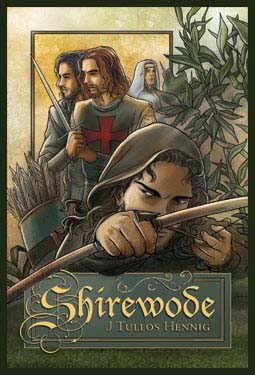
Is it possible to have worked on a book for nearly 30 years? No, strike that… a lifetime?
You see, my novel Shirewode will be released on 09 September, the second book in a duology of Robin Hood. It is singular amongst other recent retellings of the legend, in that it melds the hard edge of historical fact with the undeniable myth and magic of a vanishing primordial forest. It also has high romance straight from the original ballads… with a subversive and timely twist, of course.
And time has haunted these books. It’s been a bloody long haul to get here, to this place where I have two actual novels in my hand instead of promises, and good reviews in print instead of well-meaning reassurances. The duology originally began over thirty years ago as a trilogy called Greenwode, on the verge of contract with an SF/F publisher. The main editor of that imprint died, and in the fallout a lot of things that were going to happen, didn’t. It was the beginning of a run with very, very bad luck on so many fronts–and we all know luck is a big factor in publishing.
I retreated from the field, done in. But the writing still lay in wait. Other books were written, shared amongst comrades, put away in the files. And amidst them waited what would become Greenwode and Shirewode, patient outlaws in ambush. These manuscripts, gift from a childhood of pretending to be Robin Hood… of hunting and running wild over ploughed fields and through thick forests, of shooting arrows and falling in ponds, of climbing trees and chasing cousins and half-wild ponies that stood in for Sheriff’s Men…
Well, these manuscripts were determined to be my debut upon a battlefield where I never again thought to stand. I’m no longer a starry-eyed twentysomething, and it was on mere chance and whim I pulled the trilogy-that-was from my file cabinets and thought about rewriting them… then did rewrite them. A lot. Then, in a process so lacking the chaos of my previous encounters that it felt like the fates were, finally, aligning beside instead of against, publication… happened. A copy of Greenwode sits in glorious colour upon my shelves. Not too long ago I got my just-as-glorious copy of Shirewode. End, yet merely another beginning, Shirewode sits on my shelf next to its mate, right between Heinlein and Herriot… and what fine company is that?
So. I spent some years railing at whatever gods would listen (still do, sometimes), but it all comes down to this:
I’m writing better books than I was thirty years ago.
Shirewode, and Greenwode, and whatever books come after are, perhaps, the books they intended to be, all along.
I met Scott at a convention. He was funny, happy, and enthusiastic. A real pleasure to be around. When he asked me to write for By Faerie Light, I agreed and I’m so pleased with how my story, “A Nightmare for Anna,” came out. Thus, I’m not unbiased about this anthology or kickstarter. Just 10 days to go to fund this kickstarter. And there’s so much more offered by Broken Eye Books than the marvelous anthology talked about below.
—

What is By Faerie Light? It’s the bump in the night, the forgotten memories, the stolen children. It’s the worlds unseen within your dreams, hidden in the trees, lost in your cupboard. It’s the tricksy, dark, otherworldly personalities of the fae.
By Faerie Light is an anthology of dark fantasy. Specifically, it focuses on the supernatural creatures you like to call fae. These are tales of moral ambiguity and emotional intensity. Frightful and fanciful. They draw from our own mythologies and folklores, but these aren’t fables or retellings of classics. There are no lessons here to learn. We just want to play with your heads.
And really, that’s our greatest joy. The fair folk are such a treasure trove of wonderful stories. They’re unpredictable and complicated. Anything can happen anywhere and anywhen. You never really know just where you stand, and even when you think you do, you’re generally wrong. They are unconcerned with your quaint customs and morals. You’re typically just a bother, a toy, a fling to them. It’s when they start to pay attention to you that you should worry.
And what better way to bring something so multifaceted, so complex, to life than in an anthology, my most favorite of beasts. You get to see through the eyes of different authors, each with their own take on what it means to be fae. What it means to be human interacting with a cold, remorseless, alien world.
Eighteen short stories woven together by the editors, Caroline Dombrowski and myself. All from top-notch authors with the knack for hitting just the right notes of creepy and weird: Jennifer Brozek, James L. Sutter, Elaine Cunningham, Erin Hoffman, Shanna Germain, Cat Rambo, Jeffrey Scott Petersen, Christie Yant, Lillian Cohen-Moore, Torah Cottrill, Erik Scott de Bie, Andrew Romine, Ed Greenwood, Amber E. Scott, Jaym Gates, Nathan Crowder, Julia Ellingboe, Minerva Zimmerman, and Dave Gross. Each bringing to life an exciting and strange new world to explore.
We’re just putting the final wards on this title now. You know, for your protection. It’ll be available to the public in November, but you could get it a little earlier by joining in our Kickstarter, which offers this anthology along with four novels and some other special goodies to choose from.
It appears you’ve heard their call already. They’re beckoning you, aren’t they? May history forgive us for unleashing this overwhelming, amoral tide of tales upon you.
Jim Hines is a friend of mine, a great writer, and I love these books. I think all readers and writers want to know what it would be like to pull something–a lightsaber, a wand, the grail–from a book to have for their very own. Here, he talks about his protagonist’s greatest love.
—
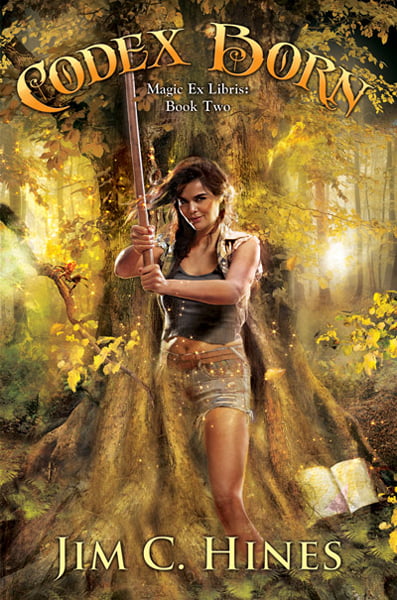
One of my favorite things about Libriomancer and Codex Born is the protagonist’s attitude toward magic. Isaac Vainio is a librarian and shameless geek, with the ability to pull things from books—phasers, light-sabers, magic rings, pretty much anything that fits through the pages.
And he loves it. Isaac is completely and utterly in love with magic … occasionally to the detriment of whatever he’s supposed to be doing at the time. Even when he’s facing steampunk-style insects that escaped from a book and are oddly determined to kill him, a part of Isaac’s mind is distracted by the beauty of their construction, the combination of magic and miniature jewels and gears, the elegance of the metalwork…
He’s constantly asking “What if?” about both the books he reads and magic in the real world. How far could Harry Potter travel with that apparating spell? Did J. K. Rowling’s witches and wizards ever blip over to Mars to explore the planet? Could magic seeds from Piers Anthony’s Xanth series be pulled into our world to revolutionize farming? And where could Isaac get his hands on a magical chronoscope that would let him check out the lost episodes of Doctor Who?
Magic comes with a cost, of course. Overusing a particular book leads to magical charring, damage that spreads through every copy of the book and can make Bad Things happen. Magic also weakens the boundaries between the lirbiomancer and the book, meaning characters from those books can begin to creep into the libriomancer’s mind. And there are the occasional monsters and villains trying to use magic to take over the world.
But the core of the series is about hope and discovery and the thrill of learning something new. It’s about an insatiable need to learn, and to explore the possibilities of magic.
I have nothing against darker, grittier fantasy novels. But there seems to be an awful lot of it these days, where the world is a harsh, ugly place, and magic is a burden to be suffered with stoicism and occasional angst.
Isaac’s life certainly isn’t perfect. Any number of things are busily trying to kill him, his love life is confusing to say the least, and he’s not on the best of terms with Johannes Gutenberg, the centuries-old founder of the world’s magical organization. I mean, what kind of author would I be if I didn’t torment my characters?
But no matter what I put Isaac and his companions through, it never takes away that central thread of joy. The thrill Isaac feels when he discovers something new or finds that a long-understood “rule” of magic was actually more of a guideline.
At the heart of the series is the idea that magic is awesome. And that’s one of the things that makes these stories such an absolute blast to write.