Today Devan Barlow tells me all about her love of -punk genre. Especially when it comes to playing around in nature-based punk subgenres.
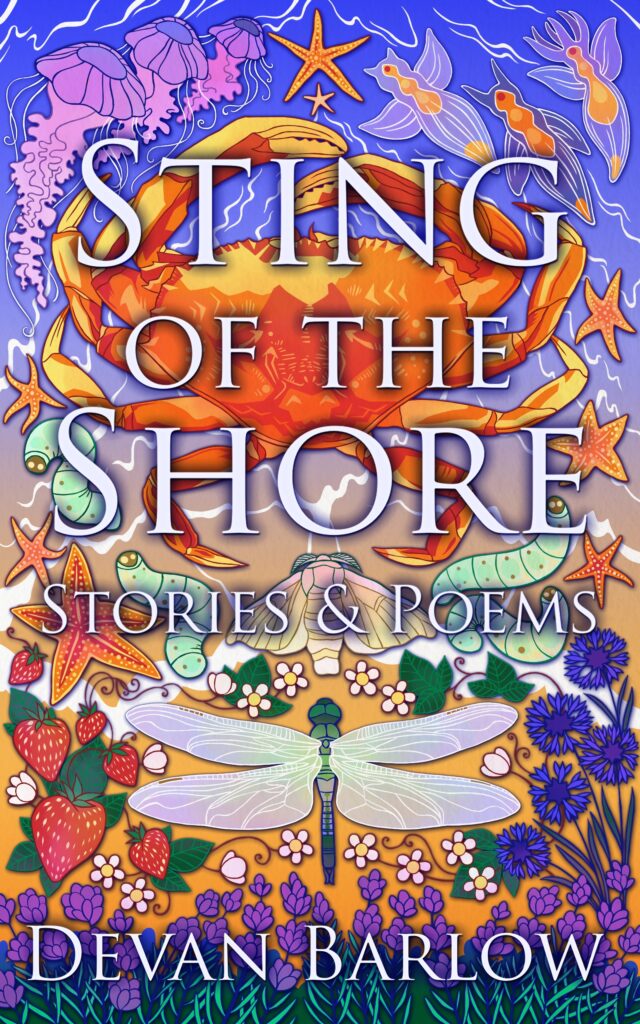 I’m a bit of a subgenre magpie. As both a reader and a writer, I’m at my happiest when surrounded by lots of different types of stories. Of course, there’s a point at which debating or worrying about subgenre labels takes time away from the important stuff — actually reading and writing! But anyone who loves stories also knows that there’s also immense power in names. And I love the promise inherent in the -punk suffix.
It isn’t a promise of purely aesthetics, much as I love the chance lunarpunk gives me to drench everything in moonlight (always a joy for a lifelong Sailor Moon fan like myself!)
It’s a promise about pushing back. About imagining variations on the way things are. About facing systems that look to harm, or divide, and saying “No.”
(Also, while we’re fighting back, we do get to revel in glorious aesthetics, because we deserve nice things.)
Over the last decade, as I first encountered the terms solarpunk, lunarpunk, and tidalpunk, there were a series of clicks in my mind. These take the promise of -punk and entwine it with settings where the natural world is deeply, dearly essential. Instead of a world where, regrettably, the environment is often ignored if not actively harmed, we’re going to do something different.
I started splashing around in these subgenre pools, clinging to that promise, and I haven’t stopped since.
I love getting to lean into the endless possibilities of the ocean with all its gorgeous and terrifying inhabitants, while imagining new ways for us to blur the boundaries between humans and ocean life. Creating sunlit settings where, regardless of whatever kind of utopia is being worked toward, people still screw up and have to do the work of cultivating healthy friendships.
Writing tales of luminous moonlight, while also exploring mental health and the connections between people and plants. An entire setting full of moon witches, saved by a dying planet by sentient citrus trees, and now working to heal the world left behind — their adventures have taken the form of several stories and poems, some in this collection (Sting of the Shore) and some yet to appear.
Even some scary pieces of vampires affected by moonlight and hungry things from ocean depths coming onto land.
Also? I adore the research. These pieces have given me the chance to wallow in fascinating research rabbit holes about moths, coral, jellyfish, pteropods, and many other inhabitants of the natural world. It’s also, unsurprisingly, a research that can be harrowing to the heart. But here’s the thing — every time we learn about our environment, every time we write about what it looks like to build healthier systems, we’re remembering that -punk promise.
Not every piece in this collection fits snugly beneath one of these particular -punk parasols (subgenre magpie, remember) but it did serve as a guiding principle as I assembled the book. I hope it brings some joy, some distraction, and perhaps some impetus to look at harmful systems in the real world, and believe we can make change.
—
Devan Barlow is the author of the Curses & Curtains series of fairy tales-meet-musicals fantasy novels, the standalone Honey and Harm, and three collections of short fiction and poetry. Her work has appeared in numerous anthologies and magazines. She reads voraciously, and can often be found hanging out with her dog, drinking tea, and thinking about sea monsters. Find her at devanbarlow.com or on Bluesky @devanbarlow.bsky.social