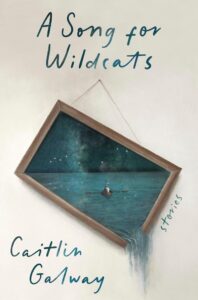
Today, Caitlin Galway tells me why everyone is a philosopher and how it affects their point of view on the world.
Everyone is a philosopher; this is a core sentiment of mine. Some are certainly more formal and exploratory in their reflection, but we all meet with life’s great abstractions, and we all carry doubt and curiosity. Most of us will, in one way or another, attempt to pin some logic to our grief, purpose to our existence, shape to our sense of self.
The characters in my collection, A Song for Wildcats, pull such introspection to the forefront of their experiences. Each story explores some form of grief, trauma, and intimacy while spanning distinctly different settings, from an Irish peninsula at the height of the Troubles, to the Corsican seafront during the 1968 student revolts. But they also squint through a metaphysical lens, and my characters (like myself) often find themselves fixated on unanswerable questions: What defines love and violence? How far back should blame extend? What’s the essence of self, especially if self is fluid, and how does one hold onto it?
“The Lyrebird’s Bell,” for example, follows the friendship between two young girls in the isolated bush of 1940s Australia. Facing a severe, lonely homelife, each girl crafts stories, often unsettling and fantastic ones, that are somehow more rational and less painful than the truth. As one girl is consumed by these fantasies, the other grows desperate to remain grounded in reality. In doing so, she begins to question what constitutes reality—and as no one person’s reality is definitive, whose versions are worthier, or more valid?
As I wrote the collection, I rediscovered a love of philosophy, particularly the works of Plato. (Even the title A Song for Wildcats is a little wink to Homer’s Iliad—due to what we’ll call an “enthusiasm” for ancient humanism.) It became an obsession—a healthy obsession, I would argue—which drove me to make dramatic shifts in my life. I gradually began to reconfigure my relationship with human interaction, identity, and the world around me—all of which led me wandering quietly through mountains, sitting alone in faraway villages, and more deliberately layering my work with metaphysical questions to which I’ve long been intuitively drawn. If grief does not leave us, when does it become wisdom? Why does suffering lead toward deeper empathy for some, and for others, a desire to harm?
However, I did not want to write a textbook, nor would I condescend to readers by assuming they required easy explanations. Instead, my hope was to offer stories in which the various layers—such as narrative, emotional, symbolic, and philosophical—connect patiently and meaningfully, so that one does not need to research ancient Greek philosophy, or Irish folklore, or twentieth-century existentialism, in order to be impacted by them. My characters are driven by a desire for connection and clarity, and it was important to me that the philosophical lens amplify each story’s heart, not clog it. These stories are my effort to capture, in my own small way, the peculiar human habit of stumbling, unwittingly, into transformation.
—
Caitlin Galway’s short story collection A Song for Wildcats has been featured as a must-read by the Globe and Mail and the Toronto Star, and named an Indigo Best Book of 2025. Her debut novel Bonavere Howl was a spring pick by the Globe and Mail, and her work has appeared in journals and anthologies across Canada, including Best Canadian Stories, EVENT, and Gloria Vanderbilt’s Carter V. Cooper Anthology, and on CBC Books.